
Skin Types
Knowing your skin type may help you develop a skin-care routine that keeps your skin looking its best. Common skin types in use today include Normal or Average, and four problem skins – Oily, Dry, Combination, and Sensitive.
The practice of grouping skins into types is relatively recent, first appearing in Beauty Culture around 1900. The earliest example I have found comes from the Institut de Beauté, a prestigious salon-based cosmetic company, later known as Klytia, founded in Paris, France in the 1890s.
Institut de Beauté
The Institut grouped skins using two criteria: 1. age – 18-25, 25-35, 35-50, and over 50 – and 2. temperament – Peaux Normales (Normal Skin), Peaux Sèches (Dry Skin), and Peaux Grasses (Oily skin). It seems strange to us today that temperaments could be interpreted as Normal, Oily, and Dry but the Institut was referring to temperaments associated with the four body humours – Sanguinous, Phlegmatic, Bilious, and Melancholic – a medieval idea that had been abandoned long ago by the medical profession but was still in circulation in a number of French cosmetic companies well into the 1930s.
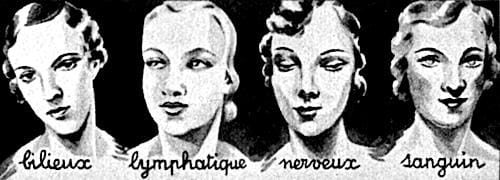
Above: 1935 Tempéraments illustrated in the ‘Dictionnaire soins de beauté’ by Tho-Radia.
The medieval temperaments were thought to be the result of imbalances in the four body fluids – blood, phlegm, yellow bile, and black bile – which could be seen in the condition of the skin. For example, clients with an oily skin were described by the Institut as having “sanguine or congestive skin, with shiny epidermis or dilated pores, with lymphatic temperaments, or with thick, distended, and shiny skin”. Those with dry skin had “bilious temperaments, were nervous and anaemic, or had weakened and relaxed muscles”.
See also: The Complexion
Blemishes and types
The way the Institut viewed skins differed from ideas common in the previous century. Dry and oily skins were often mentioned in the nineteenth century but were considered to be skin blemishes that needed to be cured, rather than inherent skin conditions that required management. The extract below is typical of the cause and effect views prevalent in the nineteenth century with cures generally based on removing the causes.
[A] dry skin may be the result of too profuse a use of soap, which frequently removes too much of the sebaceous secretions of the glands. The skin soon becomes coarse and dry when deprived of its natural oil; and this condition is also often brought about by using too much powder or sitting too near a fire. Powder or any cosmetic, even if used moderately, should always be washed off on retiring, and the water should be warm. It is best not to use soap for a dry skin, unless it is of the purest kind.
(‘Beauty: Its attainment and preservation,’ 1890, p. 294)
Unfortunately, as skin types and skin blemishes are both are skin problems, the distinction between them is often blurred and they are frequently grouped together as, for example, in this extract from Modern Screen (1942) which lists skin-care routines for Normal, Sensitive or Dry, Over Oily, Blemished, Chapped, and Mature skins.
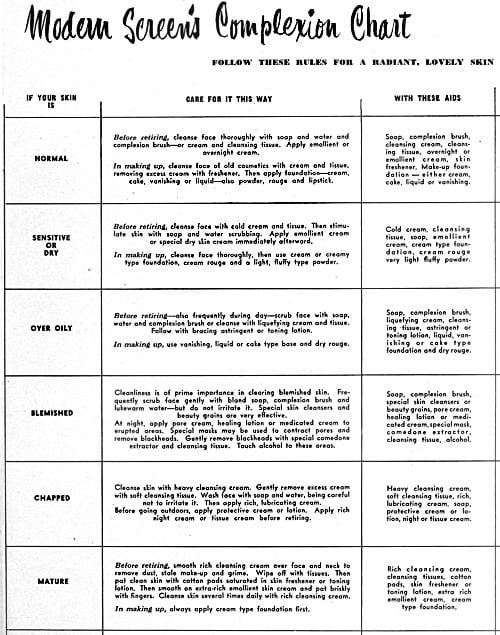
Above: 1942 Modern Screen Complexion Chart.
The Insitut’s claim that skins need ongoing treatment was an important development in the history of Beauty Culture as it also included Neutral skin types which presumably did not need to be cured. This meant that all women, even those with Normal or Neutral skin, would benefit from regular visits to the salon and/or from home treatment routines using cosmetics supplied by the salon. Clearly, a profitable idea.
The Institut later dropped the age classification but added a fourth skin type – Peaux Delicates ou Hyper-Sensibles (Delicate or Hypersensitive Skin). I hastened to add that this is not equivalent to the Sensitive skin type we refer to today.
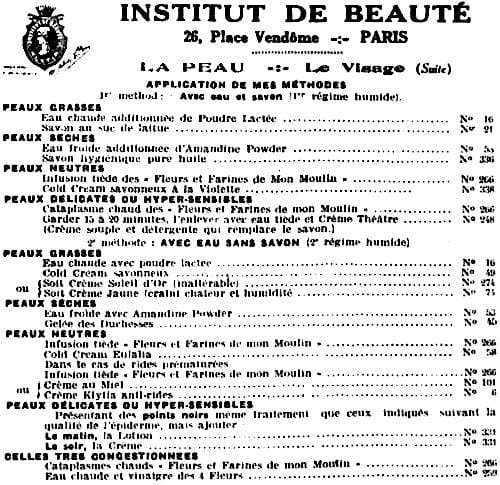
Above: 1928 Klytia treatment regimes for four different skins with or without soap.
See also: Klytia
The Institut de Beauté was not the only French company to develop treatment plans for different skin types around this time. Maison Desfossé (Académie Parisian de Beauté) also advertised treatments designed to keep Neutral, Dry, and Oily skins in their best condition.
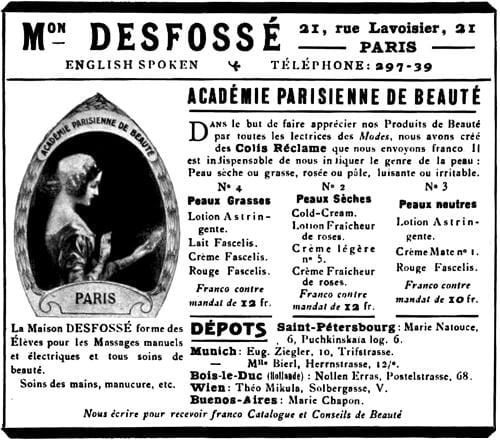
Above: 1912 Desfosse skin treatments for Peaux Grasses, Peaux Sèches, and Peaux Neutres.
Helena Rubinstein
The next important development in the history of skin types comes from Helena Rubinstein [1872-1965]. In a chapter of her booklet (c.1908), headed ‘The Skin: Normal and Abnormal’ she discusses skin variations based on writings of Dr. Ivan Bloch [1872-1922] a Jewish German dermatologist, psychiatrist and psychoanalyst, better known for his books on the science of human sexuality. These describe the causes of Greasy and Dry skins only in physiological terms, leaving out the temperaments used by Klytia, so is much closer to the way we see skin types today.
The normal velvety gloss of the skin possesses aesthetic significance. It is produced by the evenly measured excretion of the moisture and fat-secreting glands. Abnormal diminution or increase of these secretions make the skin either dry and dull or unduly moist and greasy, whereby in either case the beauty of its lustre, the ‘enamel,’ disappears.
It appears most convenient to begin with the simple division of the human skin into two classes, the dry, and the greasy or moist.(Helena Rubinstein, c.1908, p. 7)
Like Klytia and Desfossé, Rubinstein used skin types as the basis for developing her ongoing treatment plans. For Normal types she suggested Skin Food Valase and Valaze Complexion Powder. Mild Dry types could also use Russian Skin Food Valase but switch to Novena Cerate if the dryness was severe, with the fatty Novena Poudre to be used as a face powder. For Greasy skins she recommended Novena Herbal Soap or Novena Complexion Soap to dissolve the fat followed by the astringent Novena Extrait, with Valaze Herbal Powder used to help absorb any additional secretions. These initial recommendations changed over the years as she added new products to her inventory.
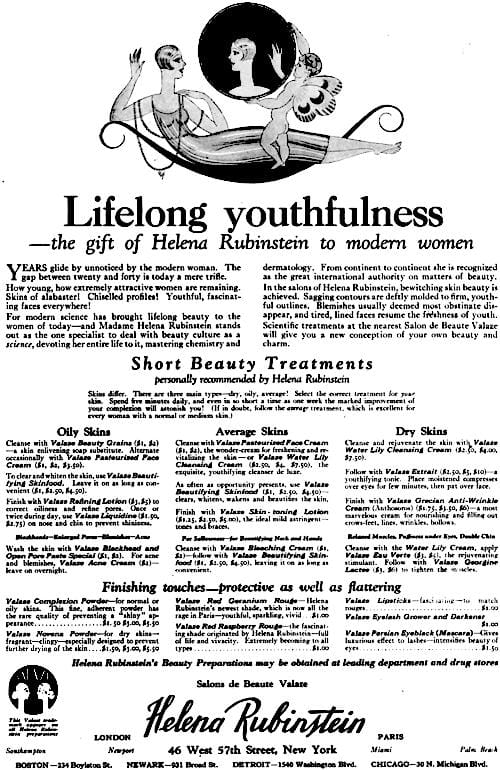
Above: 1925 Helena Rubinstein skin types.
Dry skin and sun damage
Helena Rubinstein’s global empire may have helped spread the concept of skin types resulting in other cosmetic companies adopted the idea during the following decades. However, this marketing strategy only became really popular in the 1930s when there was dramatic increase in the incidence of Dry skins. In the United States, various causes were suggested for the rise including an increased use of air conditioning and the overuse of astringents. However, it is my belief that the main cause was the escalating levels of sun damage produced by the sun-bathing craze that began in the 1920s. Sun-damaged skin looks rough and is generally thought of as Dry. In response, many cosmetic companies added Dry skin cosmetics to their inventories, some also adding additional treatment sets for other types of skin.
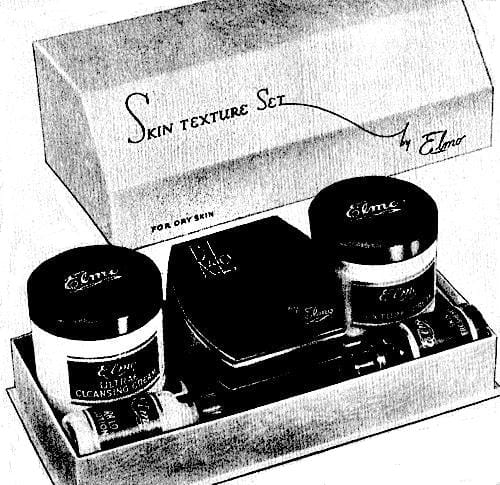
Above: 1936 Elmo Treatment Set for Dry Skin.
See also: Dry Skin Treatments
Not everyone followed this marketing plan. The adverse economic conditions of the 1930s saw some companies head in the opposite direction, developing all-purpose creams that could be used across all skin types and replaced a number of speciality cosmetics with a single product.
See also: All-Purpose Creams
The 1930s proved to be a high point on the path to the general acceptance of the idea of skin types. The marketing campaigns developed by cosmetic companies during this period firmly planted the concept into the minds of the average consumer along with the supposed benefits of following an appropriate treatment plan. Most of the larger companies produced different cleansers, toners, skin creams, and/or make-up for Normal, Oily, and Dry types. In some cases this extended to a new variation on the Oily/Dry divide – Combination skin.
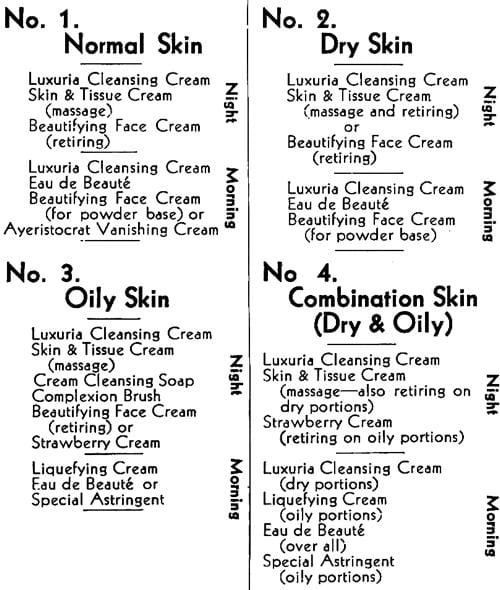
Above: 1934 Harriet Hubbard Ayer morning and night treatment for Normal, Dry, Oily, and Combination skin types.
Combination skin
Individuals with Combination skin have parts of the face that are Oily and others that are Dry. The idea is generally credited to Helena Rubinstein who also referred to it as Mixed Skin. I don’t have a firm date for when Rubinstein first used the term but it was probably in 1928 or 1929.
The combination skin is a temperamental skin!—and at first its care seems complicated. But it really is a very simple matter. Each part should be considered separately and treated accordingly. Around the eyes, the cheeks and forehead where the skin Is dry, treat It exactly as you would a dry skin—cleansing with cream and nourishing with rich skin foods. Where oil abounds on the chin and nose, wash frequently, stimulate daily and use your astringent regularly.
(Rubinstein advertisement, 1929)
Some women have what I call “mixed skins,” that is, the skin is dry on certain parts of the face and oily on others, as for instance dry on the cheeks and chin with the nose and forehead oily.
(Rubinstein, 1930, p. 33)
There were varying ideas on where the oily and dry patches were positioned in Combination skin. Some thought the oily area extended down the centre of the face but most beauty experts today refer to the T-Zone which extends across the forehead and down the nose and chin.
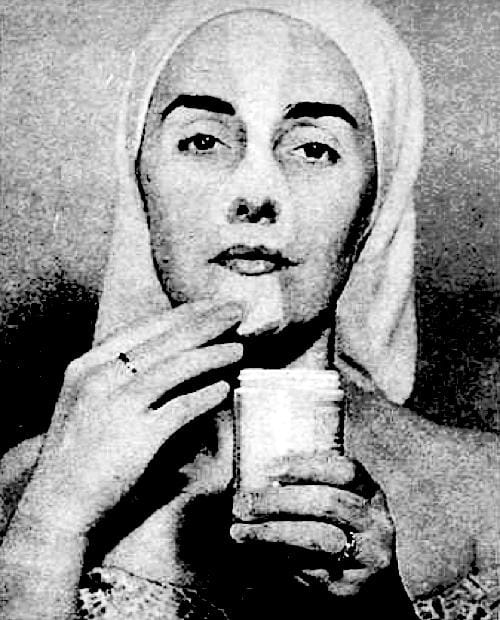
Above: 1946 Combination skin with the oily zone area marked down the centre of the face.
Moisturisers
The introduction of the moisturiser in the late 1950 changed the way Dry skin types were described. Moisturisers redefined Dry skin as a lack of water not oil and were soon advertised in a wide range of skin-care cosmetics and make-up. Some were developed to cater for specific skin types but others were marked for general use.
To a certain extent, moisturisers undermined the usefulness of the Dry/Oily divide as all skins were now believed to benefit from them. Greater use of sunscreens or physical sun blocks like umbrellas, hats, and clothing also reduced the amount of rough, sun-damaged skin that is mistakenly considered to be Dry. However, the moisturiser continues to support the idea that all skins need ongoing maintenance. Toners are no longer generally considered important in beauty regimes, and cleansers may only be needed if make-up has to be removed but starting the day with a moisturiser is often recommended as a good way to keep your skin in good condition.
See also: Moisturisers
Current situation
Marketing cosmetics for specific skin types is no longer at the levels reached in the years before and after the Second World War. However, if customers consider it an important concern when choosing skin-care and/or make-up they have numerous cosmetics available in all categories for their consideration.
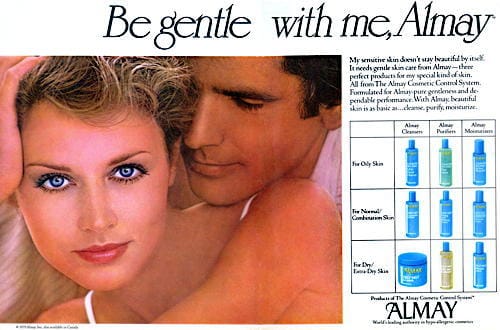
Above: 1979 Almay skin-care for Sensitive skin types available in Oily, Normal/Combination, and Dry/Extra-Dry forms.
First Posted: 18th May 2025
Last Update: 8th December 2025
Sources
Beauty: Its attainment and preservation. (1890). New York: The Butterick Publishing Company.
Helena Rubinstein. (c.1908). Beauty in the making [Booklet]. UK: Author.
Klytia. (c.1927). La beauté c’est toute la femme [Booklet]. France: Author.
Rubinstein, H. (1930). The art of feminine beauty. London: Victor Gollancz, Ltd.
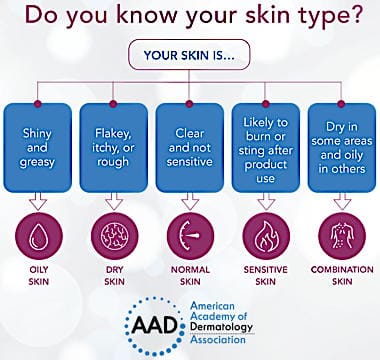
Five skin types as classified by the American Academy of Dermatology Association.
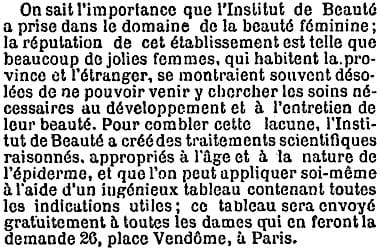
1904 Institut de Beauté (Klytia).
Trans: We know the importance that the Beauty Institute has taken in the field of female beauty; the reputation of this establishment is such that many pretty women, who live in the provinces and abroad, were often sorry for not being able to come to the salon in person to develop and maintain their beauty. To fill this gap, the Beauty Institute has created a series of scientific treatments, based on age and the nature of the skin, that can be personally applied using the help of an ingenious table that contains all the information required; this table will be sent free of charge to all the ladies who request it 26, Place Vendôme, in Paris.
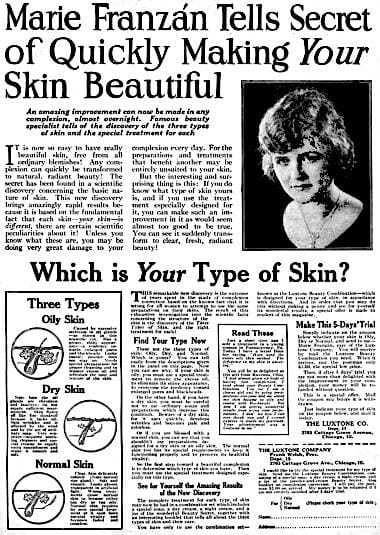
1922 Luxtone three skin types.
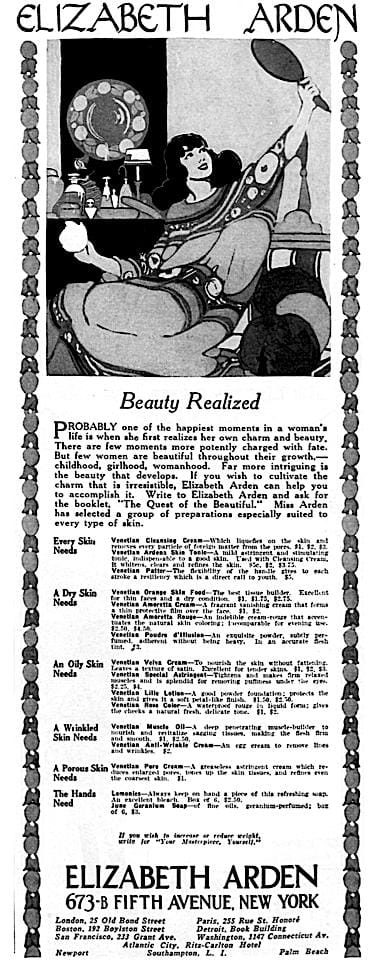
1922 Elizabeth Arden – Needs for Every, Dry, Oily, Wrinkled, and Porous skin as well as hands.
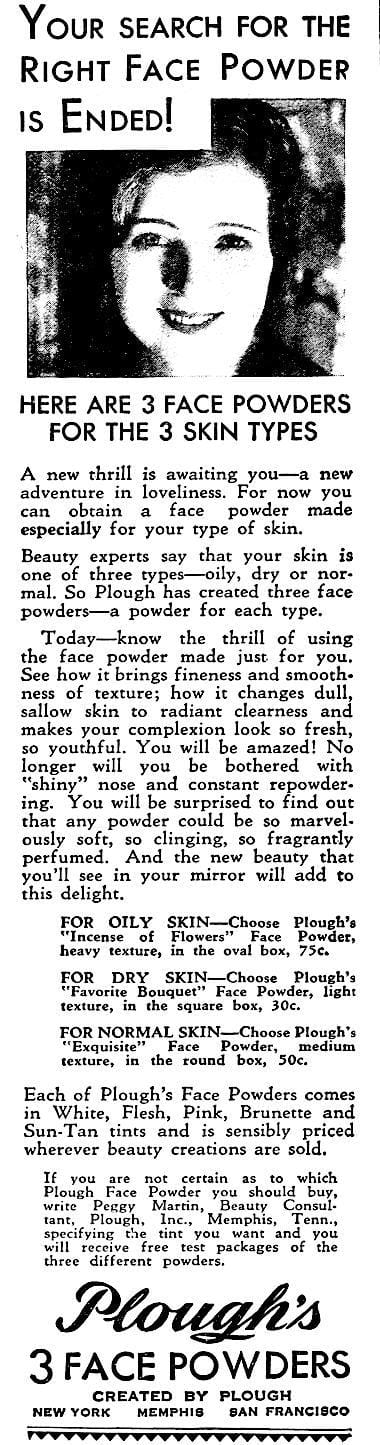
1930 Plough Face Powders for 3 skin types.
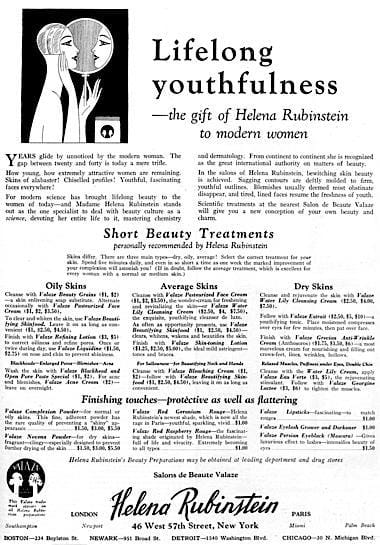
1935 Helena Rubinstein beauty treatments for Oily, Average, and Dry skins.
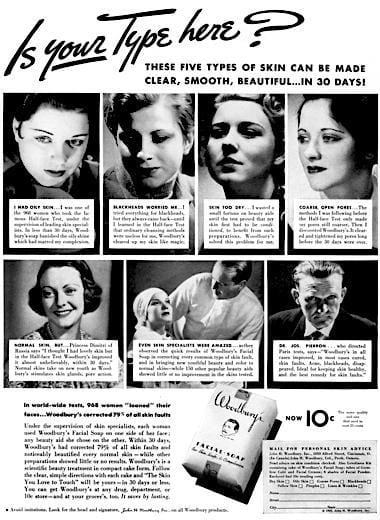
1935 Woodbury skin types – Oily, Blackheads, Dry, Coarse Open Pore, and Normal. These mix types and blemishes.
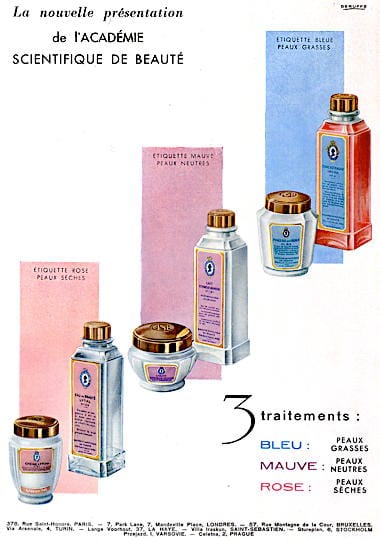
1937 Académie Scientifique de Beauté treatments for different skin types (France).
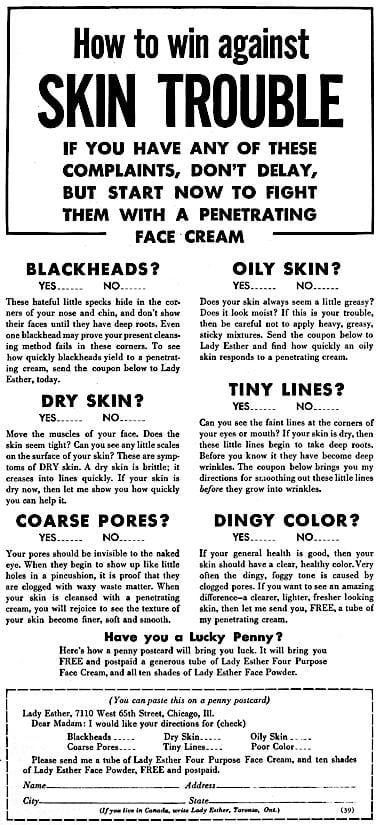
1938 Lady Esther skin troubles.
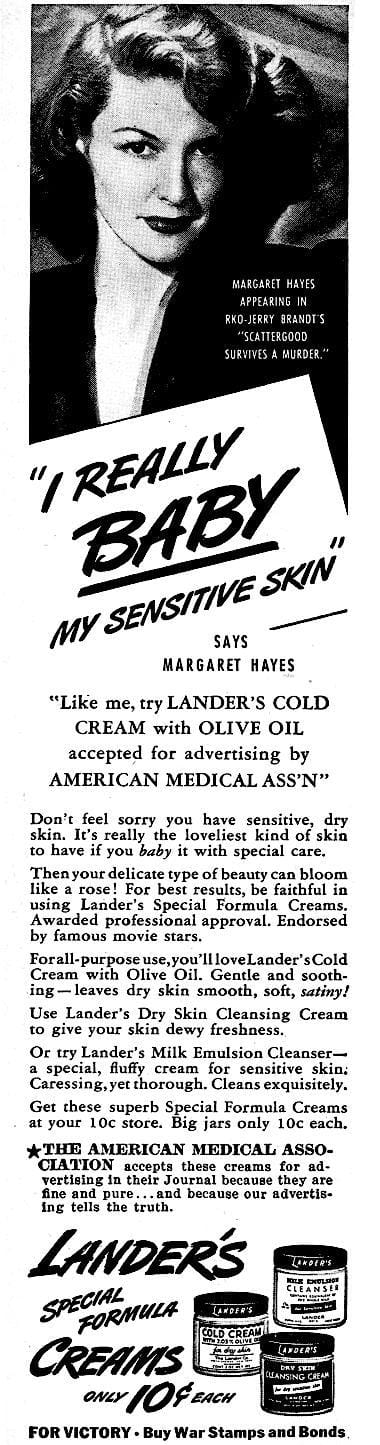
1942 Lander’s Special Formula Creams.
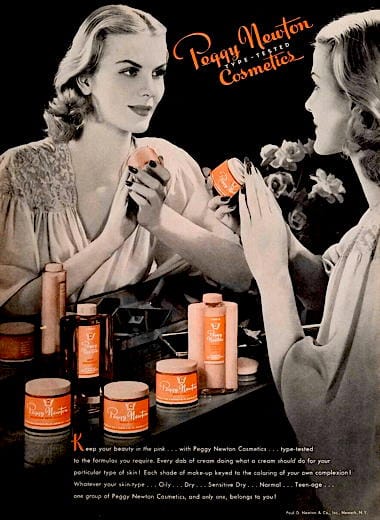
1944 Peggy Newton Type-Tested Cosmetics.
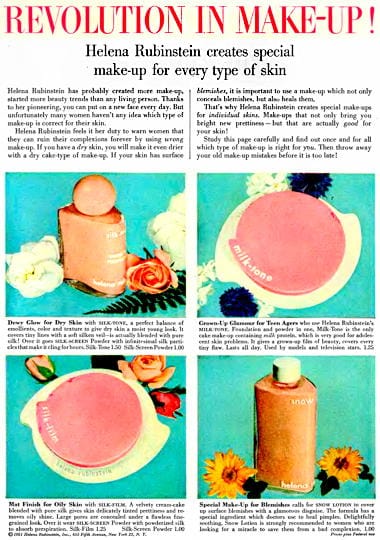
1951 Helena Rubinstein make-up for every skin type.
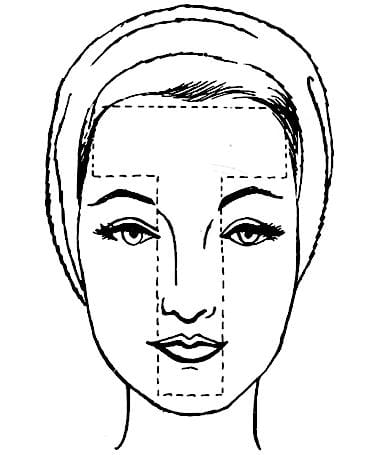
1962 T Zone. The term was in circulation no later than the early 1960s.
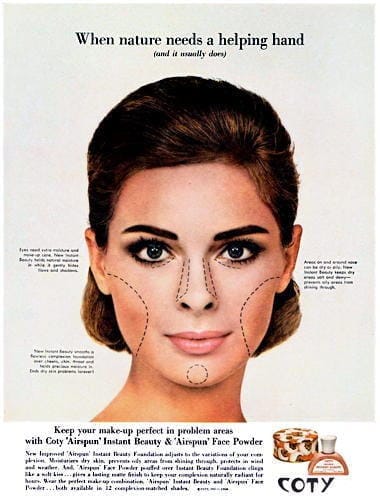
1964 Coty. Applying make-up in problem areas.