
Marie Earle (post 1930)
Continued from: Marie Earle
Coty opened a new Marie Earle salon in Paris at 15 Rue de la Paix in November, 1929. This was followed by another at the Central Club, 24 Rue d’Antibes, Cannes.
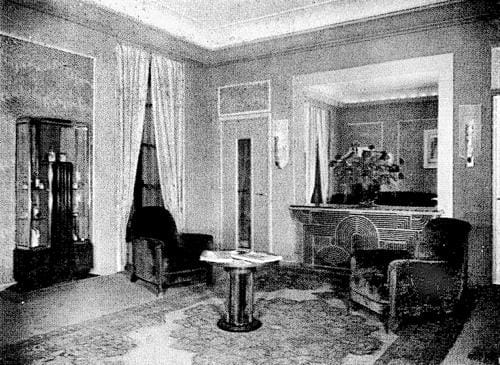
Above: 1930 Reception room at 15 Rue de la Paix, Paris. The salon was decorated by Alavoine & Co., Paris with lacquer work done by Jean Duncan.
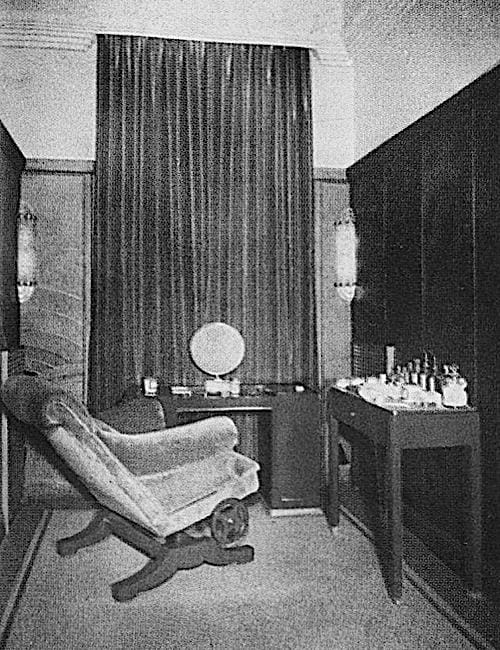
Above: 1930 Treatment room at 15 Rue de la Paix, Paris. There were six treatment rooms in all. They looked to be fitted out with Surrepos chairs designed by Dr. Jean Pascaud [1903-1966] These could be tilted back to place the client in a reclining position.
Coty also repackaged the Marie Earle line in modern lines in 1929.
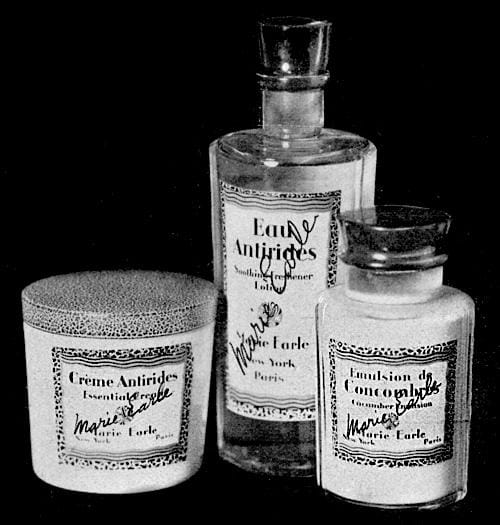
Above: 1930 Marie Earle in new packaging using a jet black, white, and jade colour scheme with lids and other decorative elements given a pebble finish.
Having acquired Marie Earle in the boom years of the 1920s, Coty now had to adjust the company to the worsening economic conditions of the 1930s. Its presence in France was maintained but the line was discontinued in Britain shortly after it was reintroduced there in 1930. In the United States, Marie Earle followed many other cosmetic companies in developing smaller, cheaper sizes of many of its lines in 1933 and updating its product packaging once more in 1934.
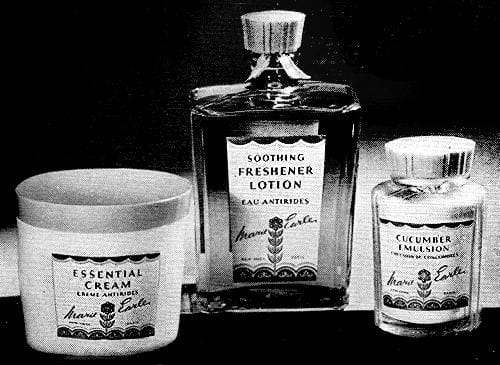
Above: 1934 Marie Earle Essential Cream, Soothing Freshener Lotion and Cucumber Emulsion in new packaging. The English names are more prominent, the pebble finish has been removed and a red rose logo has been added.
In 1932, Coty also moved the New York salon to 714 Fifth Avenue, decorating it in the Louis XVI style.
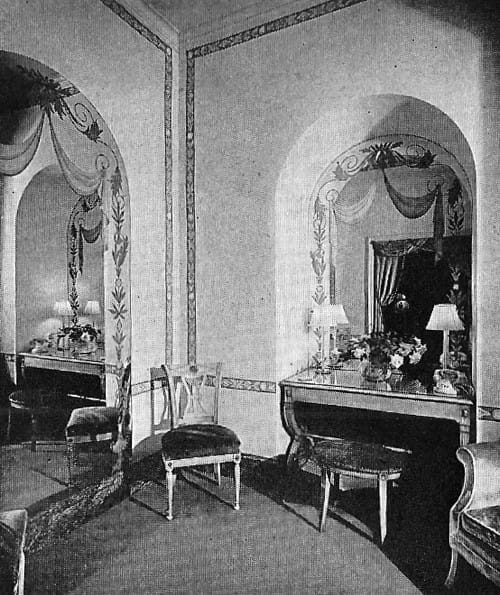
Above: 1932 Reception room at 714 Fifth Avenue, New York with mauve carpeting and rose draperies. The salon was managed by Miss Isabelle M. Whall.
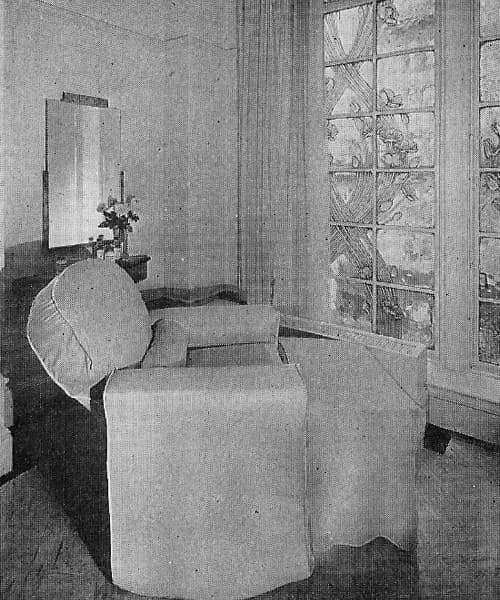
Above: 1932 Treatment room at 714 Fifth Avenue, New York. There were five treatment rooms in the salon each decorated in soft pastel peach.
Skin-care
The Marie Earle skin-care range did not change much during the 1930s. Cleansing was still done with Essential Cream, which continued to be described as being dual purpose as it cleansed and nourished. This was followed by Cucumber Emulsion, which nourished and acted as a mild skin whitener, before a toner was sprayed on. As before, the toner was selected by skin type: Soothing Freshener Lotion (Eau Anti-Rides) for Dry skin, Almond Astringent (Lait d’Amandes) for average skin, and Strong Astringent (Tonique pour la Peau) for oily skin. Day and night treatments for each skin type were also included.
Other products in the 1930s range included: Liquid Bleach, to improve the colour, texture and smoothness of the skin and remove freckles; Stimulating Oil (Huile Stimulante), an astringent applied over Essential Cream to improve skin tone and firm sagging muscles; Acne Lotion, used on the face or body for acne and over-active oil glands; Wrinkle Jelly Glaze (Gelee Anti-rRides), a face mask applied before sleeping which tightened on drying; Special Nourishing Oil, spread over the body after a bath to guard against dry skin; Special Nourishing Oil, used with Cucumber Emulsion to develop tissue in the face, neck and bust; Reducing Cream (Cream Reductrice) for slimming the fatty tissue of the face, neck, shoulders, back or bust; Marie Earle Hand Lotion; Eye Cream; Eye Wash; Eye drops; and Eyelash Grower. Many of these products had been in the Marie Earle range for decades.
Some new skin-care products were added in the 1930s including Nurimor (1934), a dry skin cream; Sunburn Lotion (1935), to promote a suntan; and Astringent Throat Cream (1935), a throat contouring cream; and .
Nurimor: “This very rich new Cream gives a softening suppling effect—lessening the depth of lines and wrinkles, greatly improving the skin tone. The rapidity and completeness of its absorption by the skin approach a degree hitherto never achieved.”
Sunburn Lotion: “[C]reamy, greaseless and tinted Rachel so that it is completely invisible. It filters out the ultra-violet rays—allows only the good sunshine to reach the skin—promotes a lovely tan.”
Astringent Throat Cream: “It prevents the first, worst throat signs of age—crepey texture, sagging muscles— keeps the throat firm and young!”
Skin stroking
Coty continued to promote the Marie Earle skin-stroking technique – rather than patting or strenuous rubbing and slapping – as the way to achieve smooth, unlined skin.
As in everything else you undertake in life, it’s not merely what you do but the spirit you put into your task which determines the measure of your success insofar as your home treatment is concerned. Just to apply your creams and lotions faithfully each night is not sufficient, when circulation is sluggish and the nerves of the face and neck are tense. Sluggish circulation must be stimulated—tense nerves, relaxed, through Marie Earle’s scientific stroking movements evolved to correct specific skin defects. Ten minutes a day devoted to the stroking movements your skin requires—and you will find youthful circulation stimulated, nerves perfectly soothed, so that the skin and deeper tissues absorb creams and lotions properly, Resultfully! Drooping muscles, puffiness, deep lines. wrinkles — these and other unwelcome “guests” — are speeded on their way by Marie Earle’s scientific stoking exercises.
(Marie Earle, 1933, p. 19)
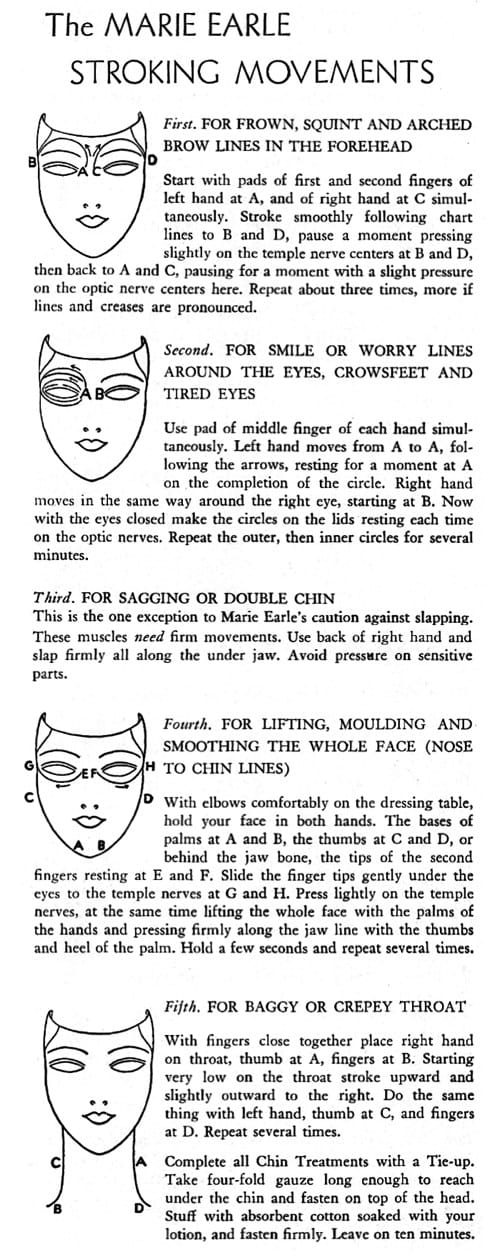
Above: 1933 Marie Earle stroking technique.
Basic treatment
Given the economy of the 1930s, Marie Earle considered it prudent to introduce a 10-minute, cut-down, skin-care routine. This Basic Treatment only used three preparations – Essential Cream, Cucumber Emulsion, and Eau Antirides.
Marie Earle gives you a basic treatment that is amazingly simple as it is effective. It consists of just three preparations. Everyone works for you. Marie Earle’s Essential Cream enriches tired skin, returns velvety softness. You use it twice, once to cleanse, again to nourish. Over the second application you smooth Marie Earle’s Cucumber Emulsion, to clarify and whiten. Finally Eau Antirides, to tone and refresh. The result? A glowing freshness that you may have thought you left behind you many birthdays past!
(Marie Earle, 1935)
The end of the 1930sintroduced additional problems. Like other companies in the United States, Marie Earle was affected by the Wheeler-Lea Act, and Food, Drug and Cosmetics Act (FD&CA), both passed in 1938. The legislation put an end to the use of terms like ‘skin foods’ and ‘muscle oils’ in the United States. Marie Earle’s settlement with the Federal Trade Commission (FTC) saw a number of lines removed from its inventory including Marie Earle Stimulating Oil, Perfection Extra Strong Bleach, and Acne Lotion and the company was also forced to reduce and/or modify its claims for other item.
See also: The FDA, FTC and Cosmetics
Make-up
As with skin-care, Coty did not alter the Marie Earle make-up routine in any major way but did increase the shade range of most of the make-up lines, adding new lipstick shades such as Vivid (1932) and powder tones such as Soleil (1933) and Roseraie (1937).
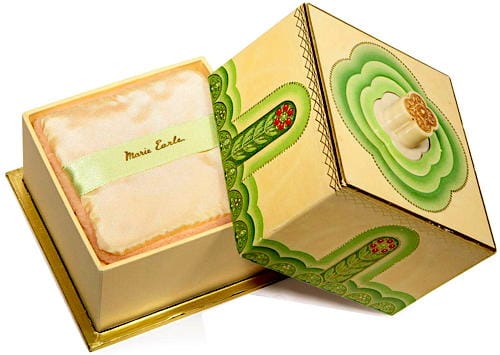
Above: Marie Earle powder box was designed and made by the Ferdinand Buedingen Company introduced in 1933.
By 1933, women could elect to use Finishing Cream (Blanc Gras) as a foundation (Shades: White, Rachel, Chair, Ochre, and Sunburn) as or use Foundation Cream if they wanted to avoid using colour. This could be followed by Paste Rouge (Shades: Extra Light, Light, Dark, and Raspberry), after which the face would be powdered (Shades: Blanche, Chair, Peach, Rachel, Ochre, Sunburn, and Soleil) before Mascara, Eye Shadow (Shades: Blue, Brown, Green, Gray, and Violet), Eyebrow Crayons, and Lipstick (Shades: Light, Medium, Dark, and Vivid) were applied. Liquid Powder could be used on the neck and at night on the shoulders, arms and hands, although Marie Earle recommended Eau Mysterious instead of Liquid Powder if the skin was oily or the weather hot enough to cause perspiration.
Coordinating all of these different shades was done by hair colour with Marie Earle developing colour-coordination plans for women with Blonde, Titian, Light Brunette, Dark Brunette, and Gray hair. Three examples are given below:
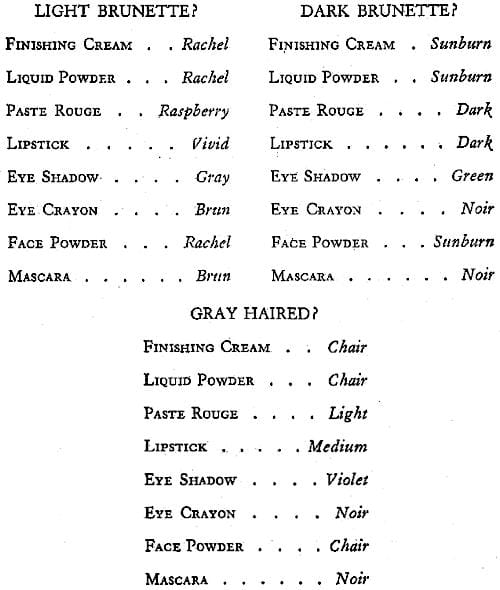
Above: 1933 Colour coordination for Light Brunette, Dark Brunette and Gray Hair.
These colour schemes were promoted using five mannequin heads. Photographs of these were used widely in Marie Earle advertisements.
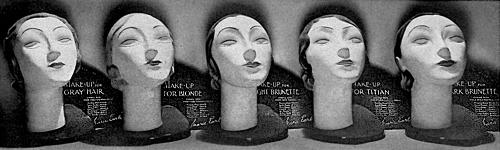
Above: 1931 Marie Earle mannequin heads demonstrating make-up that tones with different hair colours.
Also see: Understanding Your Skin (1933)
1940s
Although America did not enter the Second World War until late in 1941, the fall of France in 1940, made communication between the two countries increasingly difficult. I have been unable to find any reference to Marie Earle in France after the war so Coty looks to have shut down Marie Earle there. Coty had enough problems keeping its French business from being aryanised by the Nazis.
See also: Coty (post-1940)
Things were better for Marie Earle in the United States. New products were released during and after the war including: Soufflé Cleansing Cream (1940); Essential Foundation (1942), a creamy make-up in Rachel, Naturelle, Suntan, Cinnamon, and Tropicolor shades; Golden Morn Cream (1946), a dry skin cream; Peach Satin Cream (1947), a neck and chest cream; Araline (1948), a skin lotion; and Masque Glace (1950), a creamy facial mask. Araline changed its name to Aralinn in 1951 to better reflected its correct pronunciation, then added Aralinn Foundation (1952), a liquid cream in five shades. Marie Earle also introduced a number of new lipstick shades including Giselle, Paprika, and Red Bud.
Soufflé Cleansing Cream: “It’s as light and airy as lemon souffle . . . spreads as smoothly as a seven-minute icing. You’ll love its effective cleansing, too, and the way it leaves your complexion petal-fresh and soft.”
Golden Morn Cream: “[An] oil-rich lubricating cream created especially for sensitive dry skin.”
Peach Satin Cream: “You’ll be delighted to show off peach-satin shoulders in the new bare neck fashions after softening and lubricating your skin with this rich emollient cream.”
Araline: “[A] combination of astringents and oils which you massage into the
skin to create a younger appearance by strengthening weakened muscles and building up sagging tissue.”
Masque Glace: “[F]acial now in cream form—Is a pleasant five o‘clock pick-up. Spread its tingling coolness over face and neck, and relax for 10 minutes.”
Aralinn Foundation: “[S]mooths on, with just a light touch of the fingers . . . yet what thorough coverage it gives, masking minor blemishes, giving an even, glowing color most becoming to your skin.”
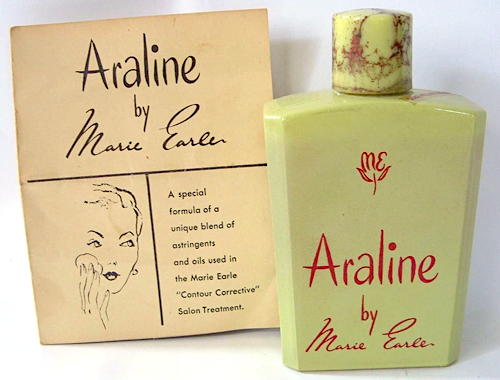
Above: Marie Earle Araline/Aralinn.
Aralinn came in two forms – Type No. 1 for dry or normal skins; No. 2 for oily skins. A daily Aralinn treatment took about 10 minutes. The skin was first cleansed and toned with Marie Earle Essential Cream and Marie Earle Skin Freshener. After being vigorously shaken the Aralinn emulsion was then patted on with cotton using a ‘press and lift’ action in places where wrinkles were appearing or on areas that needed contouring.
General Beauty Products
In 1954, Coty combined Marie Earle, Lilly Daché cosmetics and Lucien Lelong into a new company, General Beauty Products, Inc., with Lilly Daché [1893-1990] as its president. Lilly Daché, a hat designer, had a connection with Coty through her 1931 marriage to Jean Despres [1903-1988] when Despres was an executive vice-president of Coty. Daché was well known to Americans and her name was used to promote Marie Earle during the 1950s and its products from the period often carried the phrase ‘Created by Lilly Daché for Marie Earle’. Even Marie Earle Essential Cream became ‘Marie Earle Essential Cream by Lilly Daché’. All in all, this signals a brand decline.
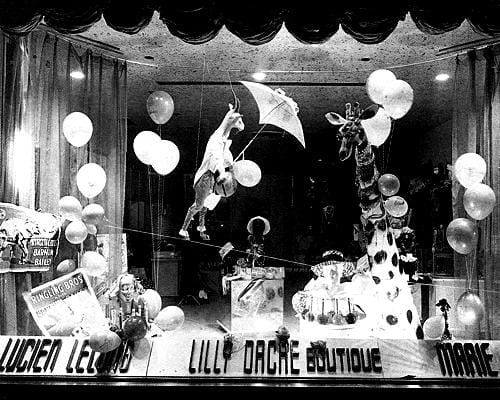
Above: Lilly Daché salon in the Plaza Hotel, New York in the 1950s. Reference to Lucien LeLong and Marie Earle can be seen on the window frame.
Skin-care
Daché made frequent trips to Paris and introduced some skin-care ideas currently in vogue there. In 1953, Marie Earle introduced Skin Vitamins containing vitamins A and D. This does not sound like a French innovation as vitamins had first been added to American skin creams back in the 1930. However, Marie Earle’s vitamins were packaged in vials very reminiscent of French serums, one vial was to be used each day to ‘treat dry, flaky, sensitive skin’. They generally came in boxes of 32 vials, a month’s supply, but Marie Earle also sold smaller, trial-size boxes with 7 vials, enough for a ‘week of beauty’.
Marie Earle Skin Vitamins: “No vitamin product, in jars or bottles, which are repeatedly opened, can guarantee uniform strength and purity. Marie Earle SKIN VITAMINS comes to you unlike other preparations—in individual application tubes. Each tube of SKIN VITAMINS contains a full treatment of pure, full strength vitamins . . . completely protected from damage of light and air because they're sealed in.”
See also: Vitamin Creams
In 1954, Marie Earle became one of the first companies to introduce royal jelly cosmetics into the United States, a beauty trend that began in France. Starting with Marie Earle Queen Bee Cream (1954), this was followed by Queen Bee Soap (1956), Queen Bee Masque, Queen Bee Foundation, and Vitae Queen Bee Moisture Emulsion. The products were still being sold by Marie Earle in the 1960s but by then the royal jelly fad was on the decline.
Queen Bee Cream: “[D]elicate, greaseless emollient for younger-looking skin.”
Queen Bee Masque: “[F]irms as it clears, smooths and refreshes.”
Queen Bee Foundation: “[W]orks for you all day long, restoring your skin’s moisture balance—giving a dewy-fresh look of youth.” Five shades.
Vitae Queen Bee Moisture Emulsion: “This pre-make-up moisturizer contains the fabulous ingredient Royal Jelly, the ‘youth-restoring’ substance in the diet of the Queen Bee. It works under your make-up to keep skin soft, supple.”
See also: Royal Jelly
Make-up
The only information I have on Marie Earle make-up during this period is that the company introduced a new gold-toned, fluted, metal twist-up lipstick case (1950), Aglow Foundation with added hexachlorophene (1955), colourless Transparent Film Foundation (1956), and Pearl Face Powder containing real pearl powder (1957).
Aglow Foundation: “ Six shades and colorless.
Transparent Film: “This marvelous liquid foundation restores the look of breathless, ardenr, just-awakened youth to a skin even dry and rough, seeming to bring back a moist, naturally fresh appearance. Colorless, and rich with emollient oils, it softens and smooths the complexion while providing a perfect foundation for make-up.”
Pearl Face Powder: “It gives a radiant, dew-fresh complexion instead of the old-fashioned powdered look.” Shades: Perle Ivoire, Perle Rosee, Perle Beige, and Perle de Soleil.
In 1955, Marie Earle also tried to convince women to mix up their own shades of powder using its Add-A-Tone Powder Wardrobe. I have not seen on of these kits but they sound suspiciously like the Luxor Powder Blending Kits that Luxor introduced back in the 1930s.
Add-A-Tone Powder Wardrobe: “This fabulous now powder wardrobe consists of 64 unit measures of pastel powders; 4 toners; measuring spoon; 2 sample bottles of Marie Earle ‘Aglo’ Foundation; Lilly Dache’s prophetic Fashion Chart; powder mixer; 12 empty boxes for the powder you blend.”
Al;so see the Luxor booklet: Now you can blend face powder to match your individual complexion (c.1930)
An undated display stand for Marie Earle by Lilly Daché also contains the names of some other lipstick and powder shades that were available in the 1950s.
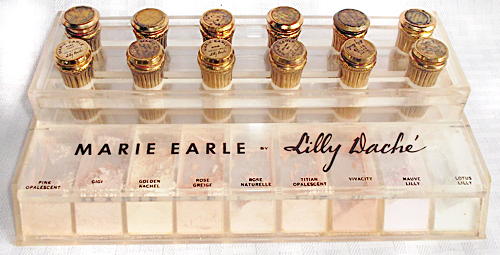
Above: C. 1956 Marie Earle by Lilly Daché powder and lipstick display.
Marie Earle Face Powders featured in the display case are Pink Opalescent, Gigi, Golden Rachel, Rose Greige, Rose Naturelle, Titian Opalescent, Vivacity, Mauve Lilly, and Lotus Lilly. Mauve Lilly and Green Lilly were purple and green powders that could be applied over others for special evening effects. There must have been other shades as Marie Earle had 12 shades of face powder in its range in 1956. These powders could be applied over Transparent Film but Marie Earle also sold tinted foundations in shades such as Blonde Opalescent, Pink Opalescent, and Titian Opalescent.
The lipsticks in the display case all appear to be in metal bamboo cases, which may have debuted in 1956. Some shades like Brilliant Red, Ruby Lilly, Golden Fleck, and Whim are indelibles but there is also Accent which was a creamy lipstick. Other known lipstick colours from the 1950s are Morning Pink, Noon Pink, Evening Pink, Vivid, Bud Pink, Sunrose, Red Roses, Dashing, and Scintillating Red.
Lilly Daché continued to offer advice on colour coordinating Marie Earle make-up. For example, in 1956, Blondes were recommended to use Blonde Opalescent foundation and Rose Naturelle powder with Bud Pink rouge and lipstick. Those with Medium colouring should apply Pink Opalescent foundation and powder with Accent or Bud Pink rouge and lipstick while Brunettes should combine Titian Opalescent foundation and powder with Accent lipstick and rouge. Grey, Grey-Bue, or Violet eyeshadow was recommended for every coloration, selected according on taste.
Ultra-smooth lipstick: never looks painted. The lovely, lustrous color remains even after creamingSale
Coty’s financial position worsened during the late 1950s partly due to its ongoing rivalry with Revlon during the American Lipstick Wars. It lost money in 1957 and 1958 and this seems to have triggered the offloading of some of its subsidiaries including the sale of Lilly Daché, Lucien Lelong and Marie Earle to Mary Chess in 1960. The divestments did not keep Coty independant and it was bought by Chas. Pfizer & Co. in 1963.
See also: American Lipstick Wars
The 1960s and 1970s saw a good deal of change in the American cosmetic market and Marie Earle went through a series of owners including Nestle-LeMur (1964) and the Hichens Chemical Company (1970) before it disappeared. A Marie Earle brand recently resurfaced but seems to have subsequently closed down.
Timeline
| 1932 | New York salon moves to 714 Fifth Avenue. Smaller sized preparations introduced. New Products: Hand Lotion, Eye Wash and Eye Cream. |
| 1934 | Marie Earle product line repackaged. New Products: Nurimor dry skin cream. |
| 1935 | New Products: Sunburn Lotion; and Astringent Throat Cream. |
| 1940 | New Products: Soufflé Cleansing Cream. |
| 1942 | New Products: Essential Foundation. |
| 1943 | New Products: Perfection Leg Make-up. |
| 1946 | New Products: Golden Morn Cream. |
| 1947 | New Products: Peach Satin Cream. |
| 1948 | New Products: Araline (Aralinn). |
| 1950 | New Products: Masque Glace. |
| 1952 | New Products: Aralinn Foundation. |
| 1953 | New Products: Skin Vitamins. |
| 1954 | Coty creates General Beauty Products, Inc. containing Lucien Lelong, Marie Earle, and Lilly Daché Hair Cosmetics. Marie Earle moves to 78 East 56th Street, New York. New Products: Queen Bee Cream. |
| 1955 | Marie Earle products repackaged. New Products: Aglow Foundation; and Add-A-Tone Powder Wardrobe. |
| 1956 | New Products: Queen Bee Soap. |
| 1957 | New Products: Queen Bee Hand and Body Lotion; and Vitae Queen Bee Moisture Emulsion. |
| 1960 | Lucien Lelong, Marie Earle and Lilly Daché sold to Mary Chess. |
| 1964 | Nestle-LeMur buys Lucien Lelong, Marie Earle and Seaforth from Mary Chess. |
| 1970 | Hichens Chemical Company acquires Marie Earle. |
First Posted: 22nd June 2015
Last Update: 21st July 2025
Sources
deNavarre, M. G. (1941). The chemistry and manufacture of cosmetics. Boston: D. Van Nostrand Company.
Marie Earle. (c.1910.). Culture rationnelle et scientifique de la beauté par Marie Earle. Paris: Author.
Marie Earle. (1924). The other side of the moon. A parable of beauty [Booklet]. New York: Author.
Marie Earle. (1933). Understanding your skin. The essential key to personal loveliness [Booklet]. New York: Author.
Jones, G. (2010). Beauty imagined: A history of the global beauty industry. Oxford: Oxford University Press.
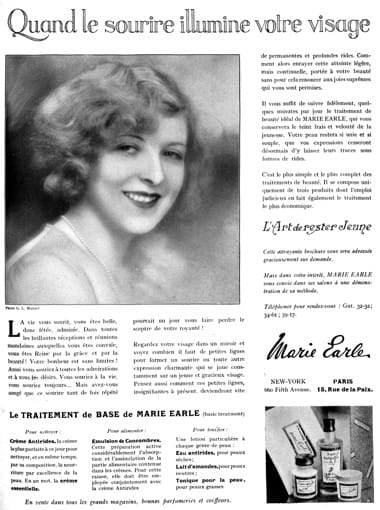
1930 Marie Earle (France).
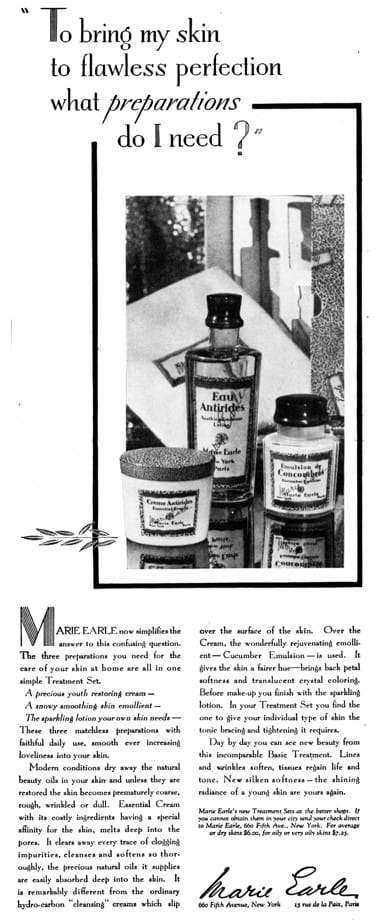
1930 Marie Earle.
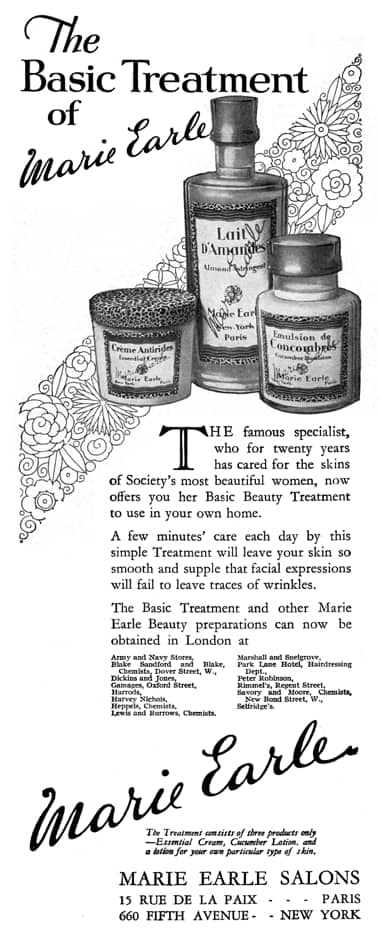
1930 Marie Earle (Britain).
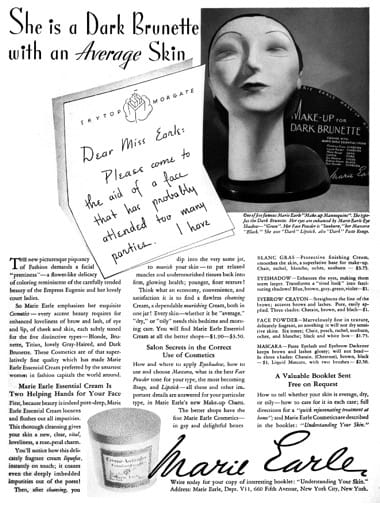
1931 Marie Earle skin care and make-up for a brunette with average skin.
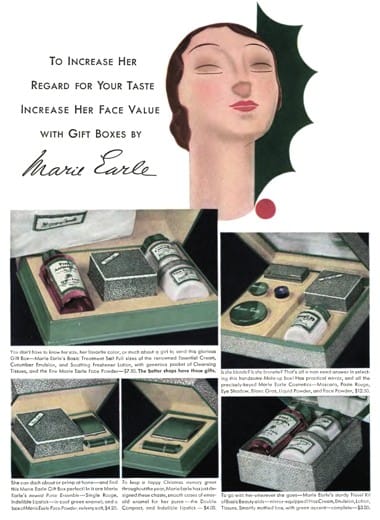
1932 Marie Earle Christmas gift boxes.
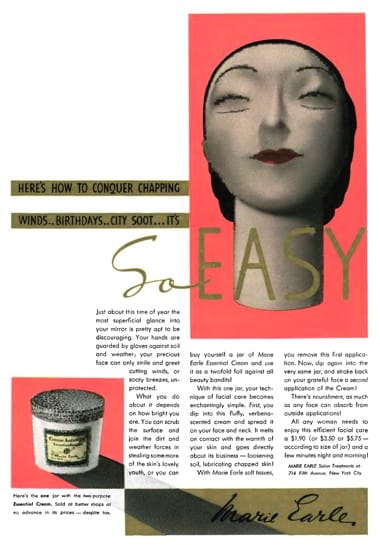
1933 Marie Earle.
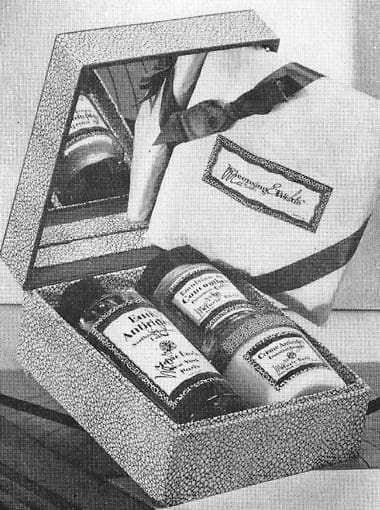
1933 Marie Earle Crème Antirides (Essential Cream), Emulsion de Conconbres (Cucumber Emulsion) and Eau Antirides (Soothing Freshener Lotion).
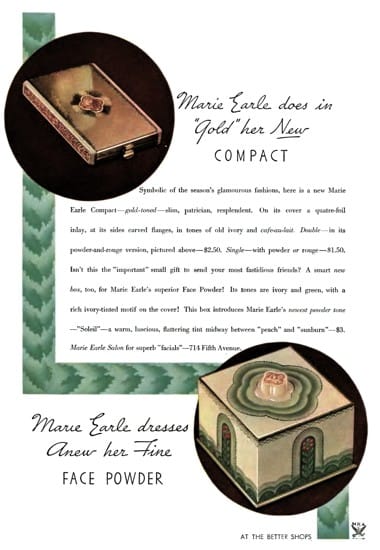
1933 Marie Earle Compact and Face Powder. The compacts in ivory and gold were available as singles or doubles. Doubles were available in Peach Powder with Light or Medium rouge; Soleil powder with Medium rouge; and Rachel powder with Medium, Dark or Raspberry rouge. Single compacts were available in Peach, Rachel, Chair, Ochre and Soleil, powder.
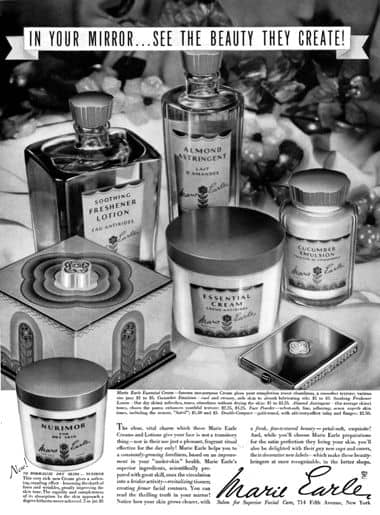
1934 Marie Earle cosmetics.
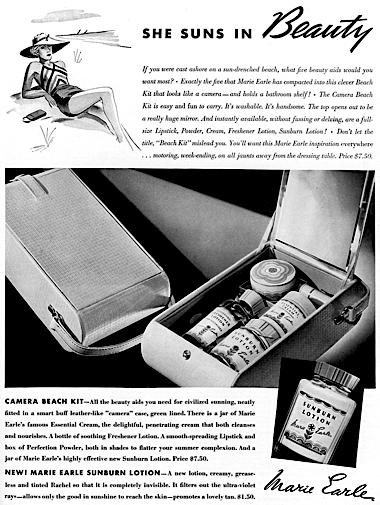
1935 Marie Earle Camera Beach Kit. A rich, green, moire waterproof container shaped like a camera case containing Essential Cream, Soothing Freshener, Face Powder, Lipstick, and Sunburn Lotion.
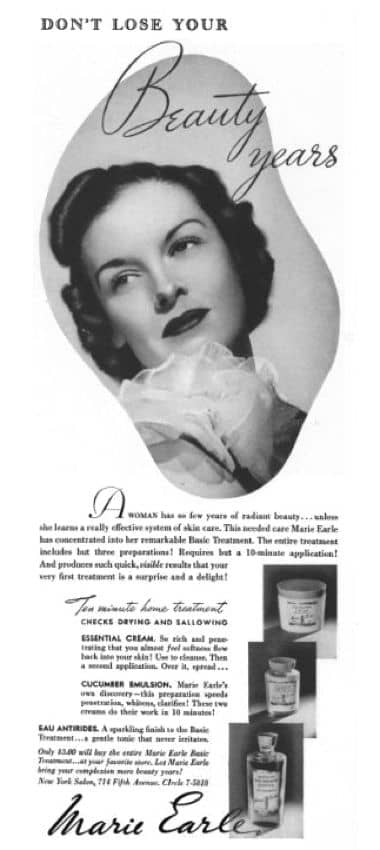
1937 Marie Earle Essential Cream, Cucumber Emulsion and Eau Antirides. These three preparations made up the 10-minute Marie Earle Basic Treatment.
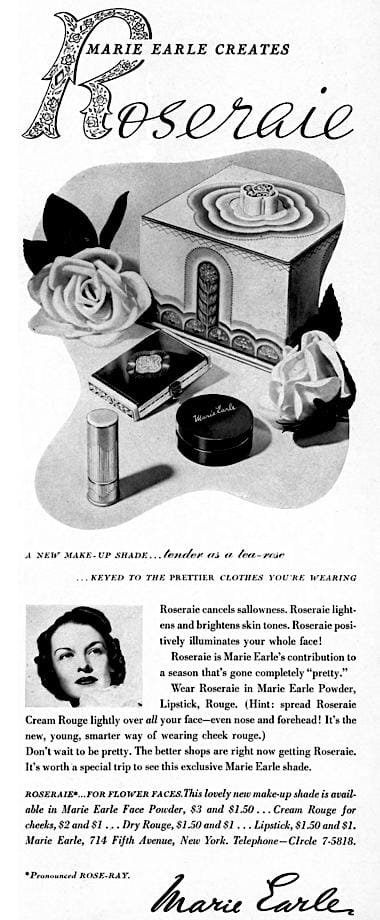
1937 Marie Earle Roseraie in powder, rouge and lipstick.
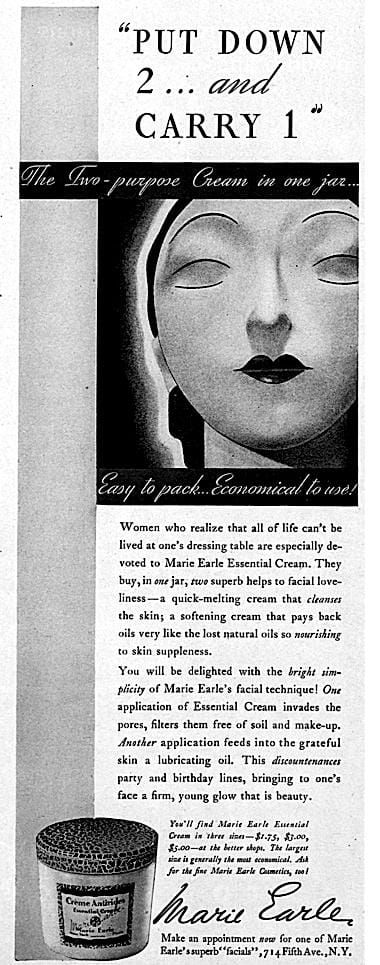
1939 Marie Earle Essential Cream advertised as a two-purpose cream.
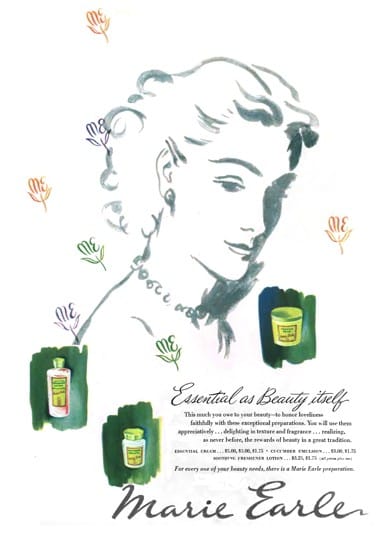
1946 Marie Earle.
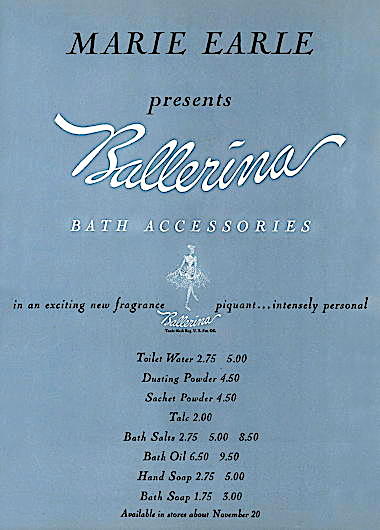
1946 Marie Earle Ballerina Bath Accessories. Based on the Ballerina fragrance (1940) these included a Toilet Water, Dusting Powder, Sachet Powder, Talc, Bath Salts, Bath Oil, Hand Soap, Bath Soap, and Bath Mitt.
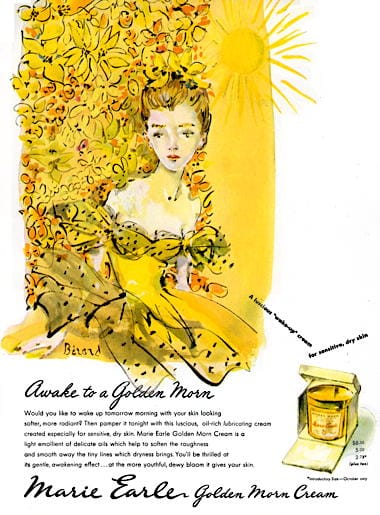
1947 Marie Earle Golden Morn Cream. The product was released in 1946 but was repackaged in a new gold-plated jar in 1947.
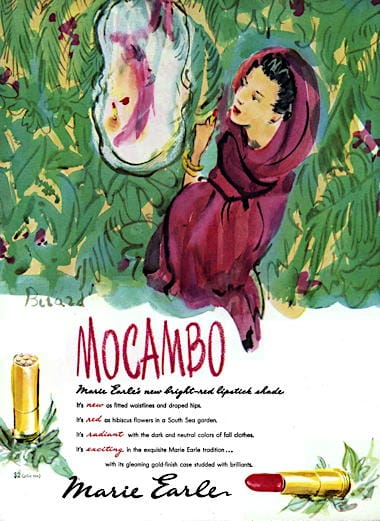
1947 Marie Earle Mocambo Lipstick.
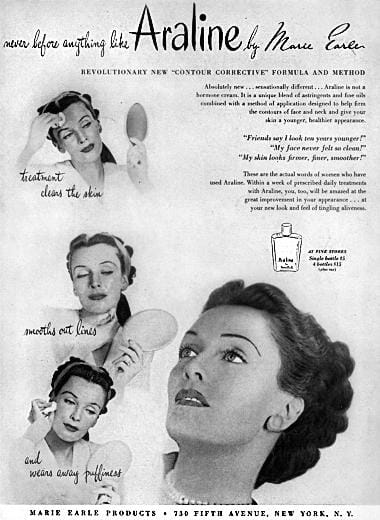
1949 Marie Earle Araline renamed as Aralinn in 1951.
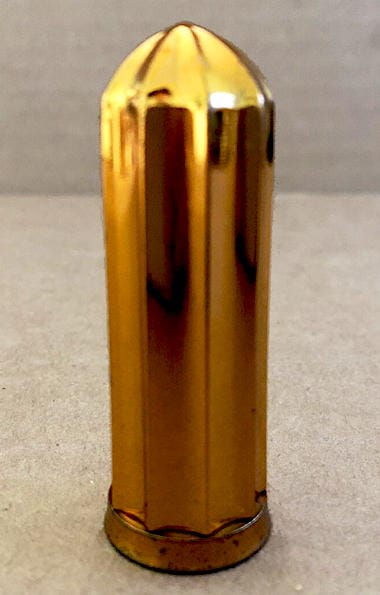
c.1950 Marie Earle Fluted Lipstick case.
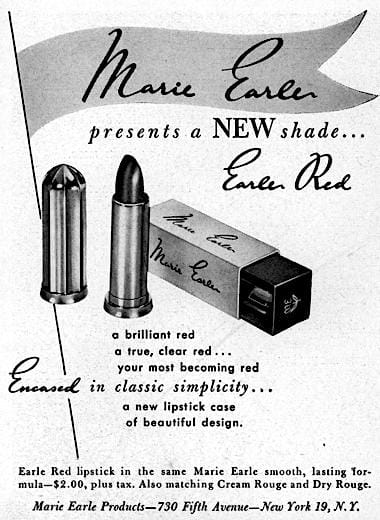
1950 Marie Earle Easter Red Lipstick in fluted case.
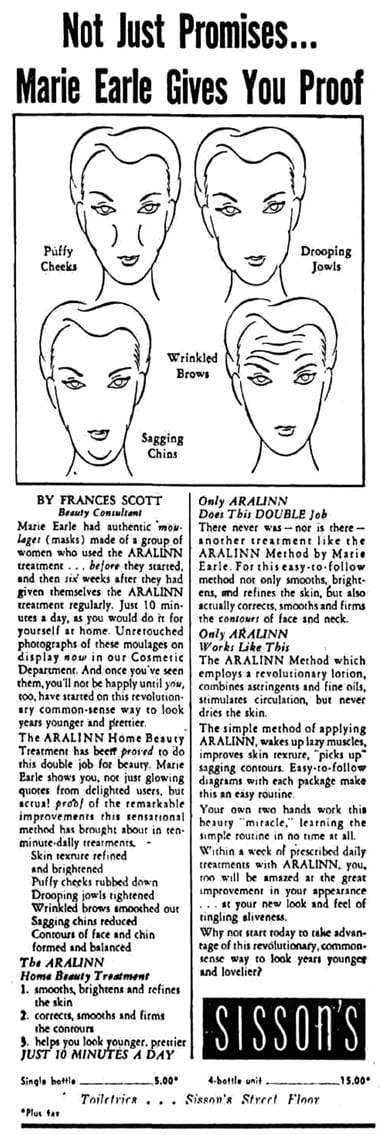
1952 Marie Earle Aralinn Lotion.
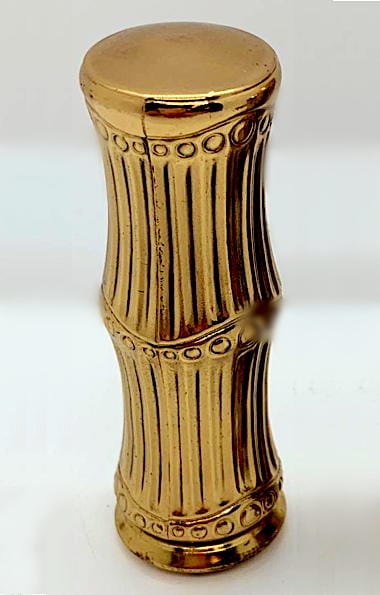
c.1956 Marie Earle Bamboo Lipstick case.
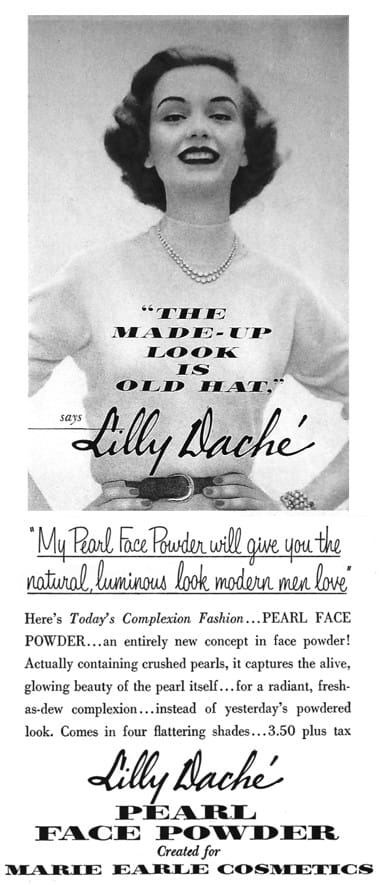
1957 Marie Earle Pearl Face Powders. Lilly Daché is more prominent than Marie Earle.
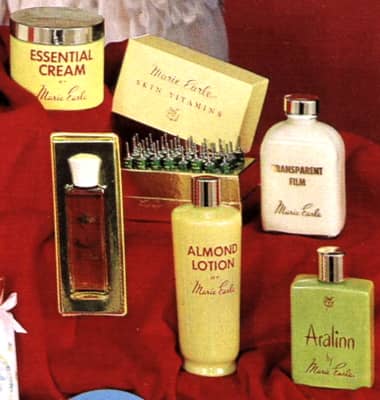
1964 Marie Earle. Some of the products sold by Nestle-LeMur.