
Potter & Moore
Potter & Moore is said to have been founded by Ephraim Potter and William Moore in Mitcham, Surrey in 1749. I have been unable to find any business records to confirm this but its creation may been a spoken agreement concerning the establishment of a distillery. The Potter and Moore families were well-established Mitcham farmers and the distillery would have been used to extract oils from plants grown in their physic gardens. It appears to have been situated on Eveline Road in Upper Mitcham, close to Figge’s Marsh and the Manor Farm.
Ephraim Potter left his estate to his son, James Potter [1734-1797], who, in turn, passed it on to James Ephraim Moore [1769-1851], the son of Ann Potter [1740-1797], James Potter’s sister, and Benjamin Moore [1744-c.1820], the son of William Moore. James Potter had amassed a considerable fortune during his lifetime and James Ephraim Moore capitalised on this, adding additional land to the estate. He is also recorded as continuing to operate a drying house and a distillery which was used to extract peppermint, spearmint, and lavender oil (Malcolm, 1805, pp. 116-133).
James Moore never married but apparently sired at least one son, James Moore Bridger [1805-1885], who inherited the business. In 1885, a representative from the trade magazine, ‘The Chemist and Druggist’, found two men, James H. and Edwin Bridger, responsible for working the farm and the distillery that made up Potter & Moore. The men were described as third generation flower-farmers whose great grandfather, was reputed to have introduced the lavender cultivation into Surrey (The Mitcham harvest, 1885, p. 562).
Despite siring three sons and two daughters, members of the bridger family did not continue the business and James Moore Bridger’s assets were auctioned off in 1888. This enabled the good will and assets of Potter & Moore to be acquired by W. J. Bush & Company.
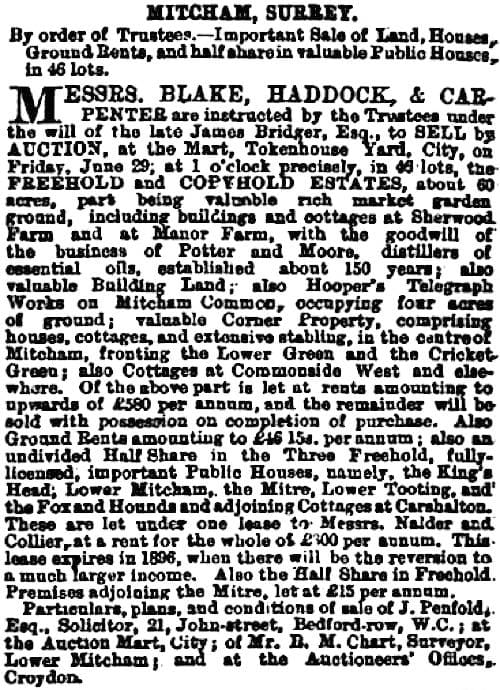
Above: 1888 Auction notice for the estate of James Bridger.
W. J. Bush & Company
W. J. Bush had been founded in 1851 by William John Bush [1829-1889], a manufacturing chemist. Starting with a small factory in Artillery Lane, Bishopsgate, London, the company produced essential oils and essences with aerated waters, confectionary, and pharmaceuticals added later. Expansion of the business saw the company open a larger factory in Ash Grove, Hackney in 1885.
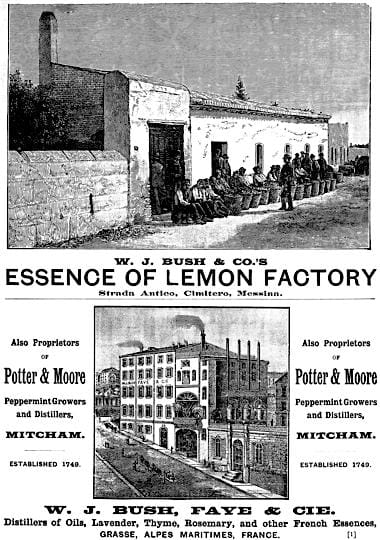
I have been unable to track developments of the Mitcham distillery following its purchase by W. J. Bush. A print of the plant, widely used in W. J. Bush trade advertisements in the 1890s, has West End Road on the side of the building rather than Eveline Road, its previous address. W. J. Bush may have been forced to move it after the farm was auctioned off. I have not found any records of a West End Road in Mitcham or Upper Mitcham but it is possible that the engraver confused Western Road for West End Road.
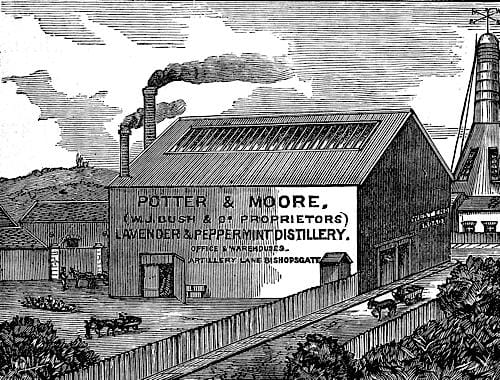
Above: 1897 Potter & Moore lavender and peppermint distillery on West End Road.
The distillery appears to have been moved at least once more as a 1930 trade directory has a record of a lavender distillery in the W. J. Bush factory in Batsworth Road, Mitcham.
Products from the distillery
In the 1890s, the Mitcham distillery was used to produced essential oils from a range of plants including camomile, lavender, peppermint, spearmint, and verbena. Like other essential oils W. J. Bush distributed these were sold these in bulk to other wholesalers. However, in 1902, W. J. Bush began selling lavender products it manufactured to retailers under the Potter & Moore name. W. J. Bush did this at the same time that it began to market perfumes and other lines from Buisson Frères, to retailers in Britain.
The first Potter & Moore lines manufactured by W. J. Bush were Old English Lavender Water, Lavender Smelling Salts, and Lavender Toothpowder. The company added Lavender Sachets by 1909, followed by Lavender Soap, Lavender Bath Crystals, and Lavender Brilliantine by 1925. Old English Lavender Water was relabelled as 1749 Mitcham Lavender Water in 1926, Lavender Face Powder was added in 1927, in Naturelle, Rachel, Rachel Foncé, and Sunburn shades, with Lavender Vanishing Cream, and Lavender Night Cream arriving in 1928.
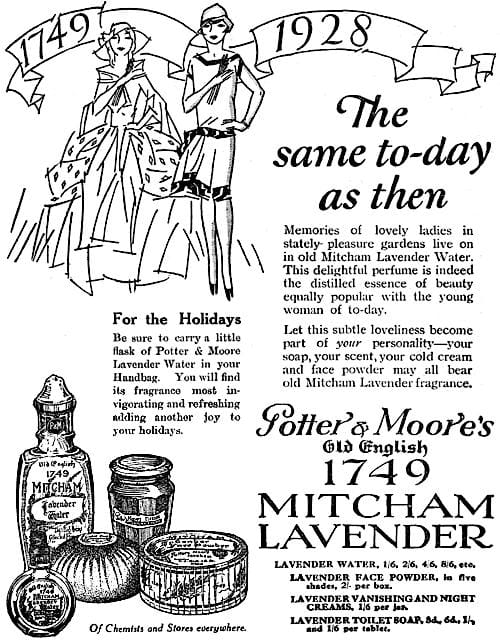
Above: 1928 Potter & Moore Lavender Water, Lavender Face Powder, Lavender Vanishing Cream, Lavender Night Cream, and Lavender Toilet Soap.
Then, in January, 1929, W. J. Bush amalgamated Potter & Moore, and Buisson Frères, into a newly created company Potter & Moore, Ltd. (capital £30,000), presumably to capitalise on the booming cosmetics market that had developed during the 1920s.
The creation of Potter & Moore, Ltd. occurred eight months before the stock market collapse of October, 1929 and it is difficult to know what effect this had on the development of the brand. I imagine that most people would not have thought that the depression that followed would have lasted as long as it did.
Potter & Moore, Ltd.
The new company added Mitcham Lavender to the names of all of its cosmetics and toiletries and began using the ‘Girl on a Pony’ image on its products and advertising. This may have been down to help distinguish them from other lavender products such as Yardley’s English Lavender range.
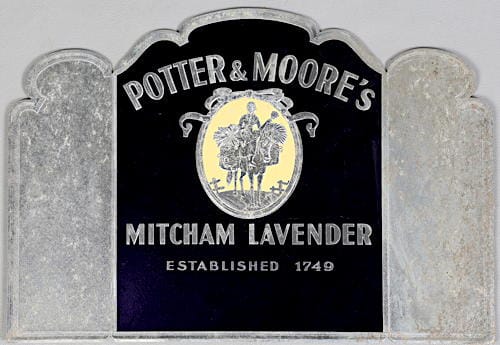
Potter & Moore display panel featuring the ‘Girl on a Pony’ image.
See also: Yardley
In 1933, the company suffered a misfortune when a large explosion destroyed the W. J. Bush factory in Batsworth Road along with twenty cottages in Belgrave Road. Twenty-three people were seriously injured, a young boy was killed, and another fifty or so houses were seriously damaged.
Manufacturing must have been moved elsewhere until a new factory was constructed on Seymour Road, Leyton. This was officially opened by Gracie Fields, a.k.a Grace Stansfield [1898-1979], in 1937.
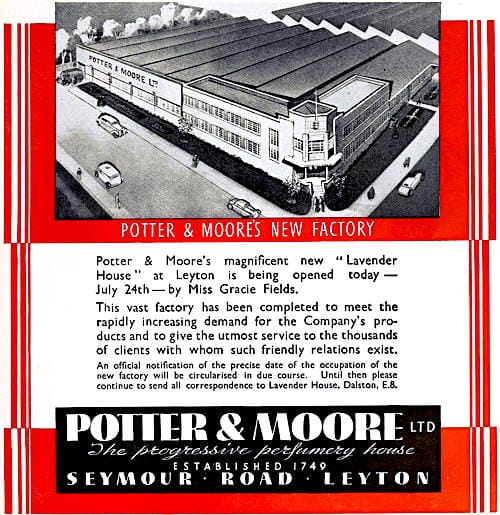
Above: 1937 Opening announcement for the new Potter & Moore factory on Seymour Road, Leyton.
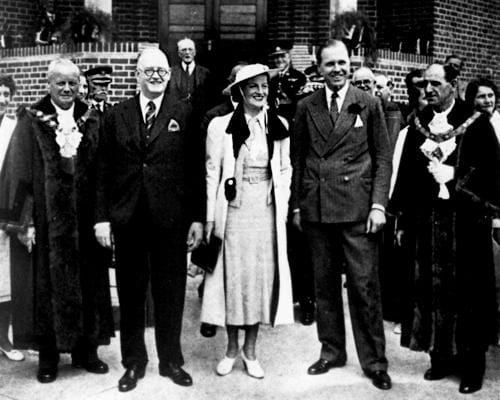
Above: 1937 Gracie Fields at the opening of the new factory in Leyton. Left, wearing glasses, is Arthur E. Pitt (chairman) with Eric Bush (managing director) to her right. The other men are the mayors of Walthamstow and Leyton.
Products
One of the first new products from Potter & Moore, Ltd. was the Purple Lilac series (1929). This replicated all the Mitcham Lavender line with products scented with a purple lilac fragrance. The vanishing creams in both series were now referred to as a Face Cream and were also available in tubes.
Mitcham Lavender Face Cream: “Use this unique skin beautifying cream as a base for Mitcham Lavender Face Powder and ensure a lovely skin for ever.’
The most important product introduced by Potter & Moore in the 1930s was Mitcham Lavender Powder-Cream, known in French-speaking countries as Crémpact. It debuted in 1930 in four shades and became Potter & Moore’s best-selling line. It was heavily promoted during the decade with many advertisements coming with endorsements from British film stars. Sold in glass containers with bakelite lids, it came in two sizes, a larger one for the dressing table which retailed at 2/6, and a smaller version for the handbag which had a mirror included in the glass base selling for 1/-. Tubes of Powder-Cream which retailed for 6d were added in 1938.
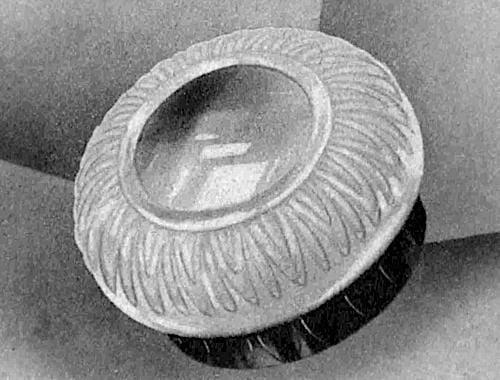
Above: Mirror in the glass base of the Powder-Cream.
Originally perfumed with Mitcham Lavender, a second version of the Powder-Cream, scented with Eau de Cologne, was added in 1934. This followed Potter & Moore’s introduction of its Blue Ribbon Eau de Cologne in 1932. I have no evidence that a Purple Lilac version was made.
Mitcham Lavender Powder-Cream: “[K]eeps the skin soft, heals every little roughness and leaves only a delicate matt finish. It is also simple and hygienic to use because no germ-carrying powder puff is necessary.” Shades: Naturelle, Rachel, Rachel Foncé, and Sunburn, with Bronze (1936), and Peach (1938) added later.
See also: Powder Creams
Potter & Moore also extended the shade range of its face powders and, by 1931, its Mitcham Lavender Face Powder, and Purple Lilac Face Powder were available in six shades – Naturelle, Rachel, Rachel Foncé, Blanche, Rosée, and Sunburn.
In 1932, Potter & Moore began selling an Anti-Mosquito Cream. Sold in tubes, it was made with lavender oil in a vanishing cream base. Potter & Moore claimed that lavender oil had been shown to be a ‘mosquitocide’.
Potter & Moore also added a Cleansing Cream in 1932. Sold in the same jars as its earlier Night and Vanishing Creams it was sold boxed with antiseptic tissues. It seems likely that it was a typical cold cream.
Another line introduced in 1932 was a ‘self-tinting’ Lipstick in two shades housed in a chromium, twist-up metal case. The colour in the lipstick was activated by moisture on the lips which suggests that it was an eosin-based indelible like the popular Tangee Lipsticks produced by George W. Luft.
Potter & Moore Lipstick: “The self-tinting principle enables the natural moisture of the lips to revive and fortify the colour.” Shades: Blond, and Brun.
See also: Tangee
Surprisingly, the lipsticks arrived two years before Potter & Moore added what appears to be its first rouge – Mitcham Lavender Blush Cream (1934). It came in a glass and Bakelite container very similar in construction to the Mitcham Lavender Powder-Cream but without a mirror on the glass base. Like the lipstick it was ‘self-tinting’ and came in the same two shades.
Mitcham Lavender Blush Cream: “[S]elf-tinting to suit blonde or brunette, is the ideal cream rouge for use in combination with the Powder-Cream.” Shades: Blond, and Brun.
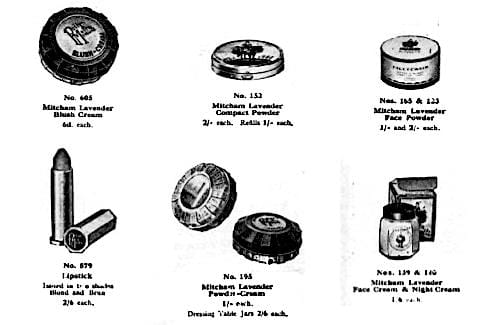
Above: c.1934 Assorted cosmetics from Potter and Moore.
Top: Mitcham Lavender Blush Cream, Mitcham Lavender compact Powder, and Mitcham Lavender Face Powder.
Bottom: Lipstick, Mitcham Lavender Powder Cream, and Mitcham Lavender Face Cream, and Night Cream.
Also see: Surface beauty is not enough (c.1938)
The last cosmetics added by Potter & Moore before the Second World War, were its Liquid Nail Polish and Oil Based Remover. Arriving in 1936 in three shades, available evidence suggests that the colourants used in the polish were dyes rather than the opaque pigments that became the predominant nail polish colourants in the 1930s.
Liquid Nail Polish: “Imparts a brilliant scintillating finish which does not crack or peel.” Shades: Natural, Coral, and Rose Pink.
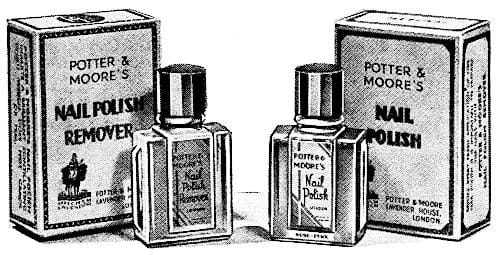
Above: 1937 Potter & Moore Nail Polish and Remover.
See also: Nail Polishes/Enamels
War
I have almost no information on Potter & Moore’s activities during the Second World War. The company largely stopped advertising late in 1940 and did not resume doing so until 1945. It is possible that Potter & Moore ceased making its Nail Polish and Remover during the war due to shortages in cellulose and the company may also have reduced its shade ranges as Rachel Foncé, and Bronze shades of Powder-Cream were not included in advertising after the war.
Things were more serious in the United States where Potter & Moore was forced to closed their branch there in 1942 due to supply problems. American operations would not resume until 1949. Similar problems were not encountered in places where W. J. Bush had manufacturing facilities. For example, Potter & Moore products were available in Australia right through the war.
Post War
Potter & Moore celebrated its bicentennial in 1949 with its parent company, W. J. Bush, marking its centennial in 1951. The continuation of rationing and high taxation meant that business in Britain remained very constrained through the 1950s but conditions were better overseas.
Some of Potter & Moore’s earnings after the war came from distributing contracts for other companies such as Dearborn (1923) Ltd., the makers of Mercolized Wax and other cosmetics.
Some new post-war lines came from acquisitions. For example, Potter & Moore began marketing and distributing Go Deodorants after they purchased Delavelle, Ltd. in 1958, the owners of Freshness, Ltd.
Products
Information on Potter & Moore’a skin-care and make-up range after the war is very sparse. I have records for a Cleansing Cream, Dry Skin Nourishing Cream, Blush Cream, Face Powder, Tinted Foundation Cream, and Liquid Foundation in its product range in 1958 but no mention of a Powder-Cream.
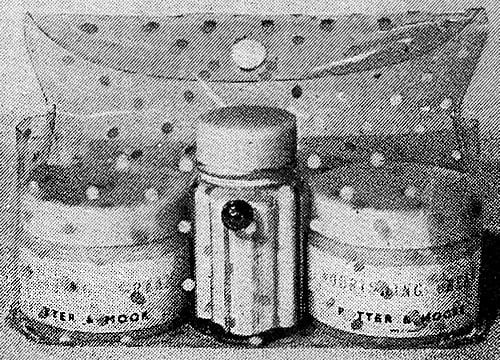
Above: 1965 Potter & Moore Christmas Pack containing Cleansing Cream, Liquid foundation, and Nourishing Cream.
Potter & Moore had added an Allure shade to its Powder-Cream in 1950 which then came in five shades – Rachel, Naturelle, Peach, Allure, and Suntan. Sales must have been declining as the company introduced what appears to be a replacement, BeautyFlo Foundation Cream, in 1957 in four shades. BeautyFlo came in what Potter & Moore referred to as ‘press-control’ container which was said to dispense the right amount of cream while being easy to carry in a purse.
BeautyFlo Foundation Cream: “[H]omogenized for extra fineness and smoothness.” Shades: My Fair Lady (Naturelle), Monte Carlo (Rachel), Riviera (Peach), and Suntone.
By the 1960s, most of Potter & Moore’s sales were in fragrances and fragrance-based products such as toilet waters, talcum powders, bath salts, toilet soaps along with a range on men’s hair care and shaving products with sales peaking at celebratory events such as Mother’s Day, Father’s Day and Christmas, events that were also important sources of sales in the 1950s.
See also: Gifts by Potter & Moore (c.1954)
Lavender had been Potter & Moore’s most successful series before the war but interest had declined after 1945. A new cream perfume developed in Australia had been very successful there and, along with talcum powders, liquid and frosted perfumes, and bath salts, this was also introduced into Britain in a range of fragrances.
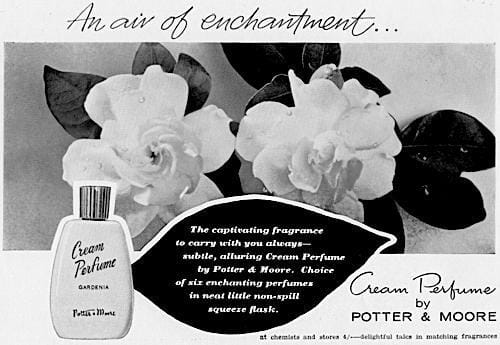
Above: 1962 Potter & Moore Cream Perfume.
Initially fragrances were named for flowers such as Gardenia, and Lily of the Vally, but later additions included more exotic names like Blue Heaven, Spring Dawn, Gold Brocade, Gigi, and Black Opal.
Later developments
In 1961, Potter & Moore’s parent company, W. J. Bush, joined the Albright & Wilson group. After Albright & Wilson combined W. J. Bush, A. Boake Roberts, and Stafford Allen in 1966, the pharmaceutical side of Potter & Moore was sold to White Laboratories, Ltd., a subsidiary of Schering Corporation in 1967. The rest of the company twas bought by E. C. De Witt & Co., Ltd. in 1968. In 2003, Potter & Moore was acquired Creightons PLC and it still forms part of that group today, trading as Potter + Moore Innovations, Ltd. However, as far as I can tell, it none of the cosmetics it produces are sold under the Potter & Moore label.
Timeline
| 1749 | Potter & Moore established by Ephraim Potter & William Moore. |
| 1888 | Potter & Moore acquired by W. J. Bush & Co. |
| 1902 | New Products: Fragrant Old English Lavender Water. |
| 1927 | New Products: Lavender Face Powder. |
| 1928 | New Products: Lavender Vanishing Cream; and Lavender Night Cream. |
| 1929 | Potter & Moore, Ltd. founded in London. |
| 1930 | New Products: Mitcham Lavender Powder Cream. |
| 1931 | Canadian branch established in Montreal. |
| 1932 | New Products: Cleansing Cream; Lipstick; and Blue Ribbon Eau de Cologne. |
| 1934 | New Products: Blush Cream. |
| 1937 | New factory opened in Seymour Road, Leyton. New Products: Liquid Nail Polish and Remover. |
| 1938 | American branch established in New York. Canadian branch moves to Toronto. |
| 1942 | American operations closed. |
| 1949 | Potter & Moore (Australia) Pty., Ltd. founded in Melbourne. Business reopened in America. |
| 1957 | New Products: BeautyFlo Foundation Cream. |
| 1958 | Potter & Moore acquires Delavelle, Ltd., including Freshness, Ltd. |
| 1961 | W. J. Bush becomes part of Albright & Wilson, Ltd. |
| 1966 | Albright & Wilson merges W. J. Bush, A. Boake Roberts and Stafford Allen to form Bush Boake Allen. |
| 1968 | Potter & Moore sold to E. C. De Witt & Co., Ltd. |
| 2003 | Potter & Moore bought by Creightons PLC. |
First Posted: 24th April 2026
Sources
The chemist and druggist. (1859-). London: Morgan Brothers.
Malcolm, J. (1805) A compendium of modern husbandry: Principally written during a survey of Surrey. (Vol. III). London: C. & R. Baldwin.
The Mitcham harvest. (1885). The chemist and druggist, October 15, 562-563.
1889 W. J. Bush & Co.
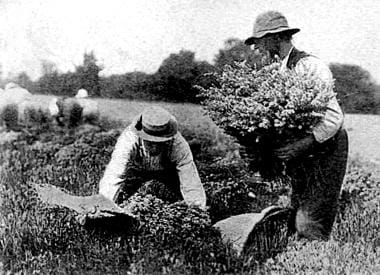
1902 Collecting lavender Mitcham.
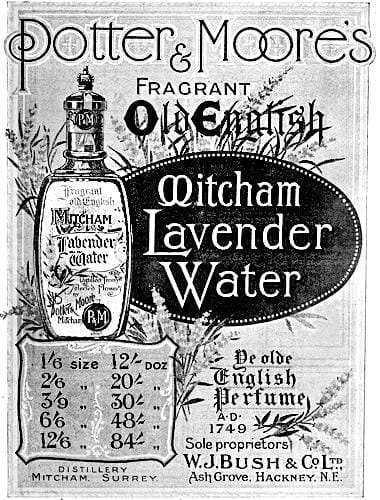
1909 Potter & Moore Old English Lavender.
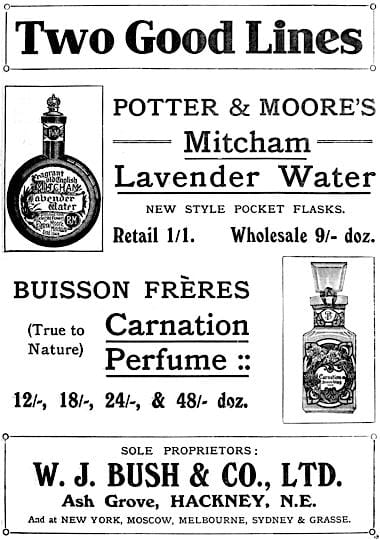
1910 Potter & Moore and Buisson Frères.
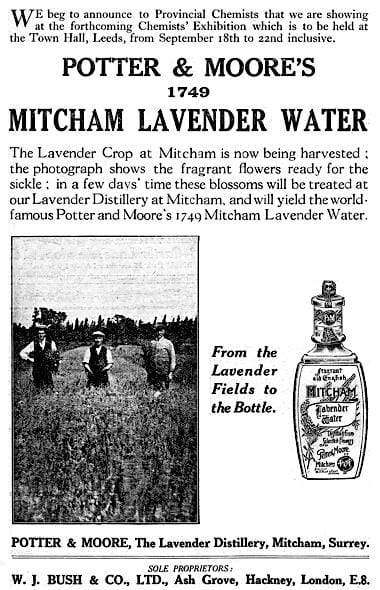
1922 Trade advertisement for Potter & Moore 1749 Mitcham Lavender Water.
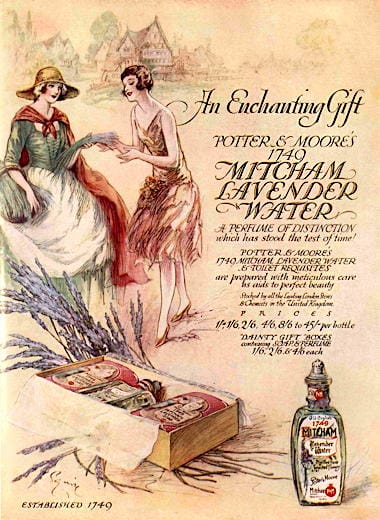
1927 Potter & Moore 1749 Mitcham Lavender Water.
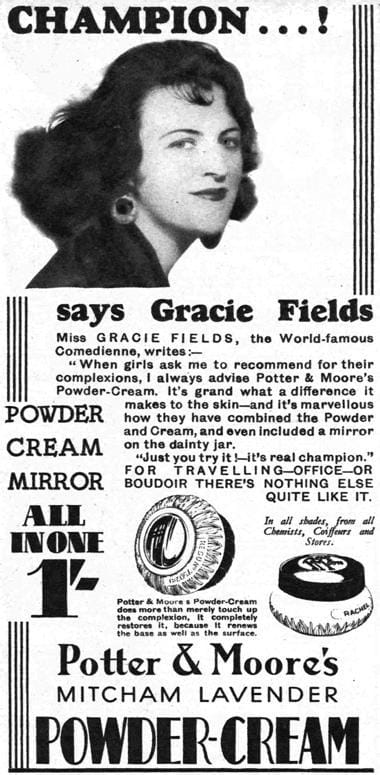
1932 Potter & Moore Mitcham Lavender Powder-Cream.
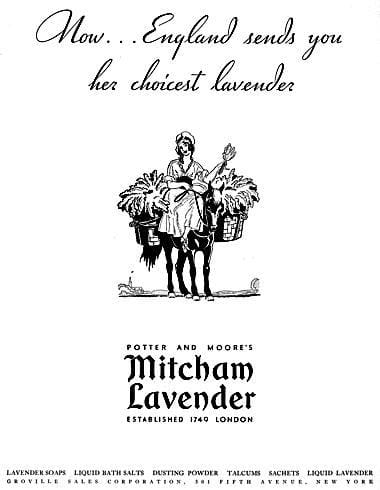
1932 Potter & Moore Mitcham Lavender distributed by the Groville Sales Corporation of New York (USA).
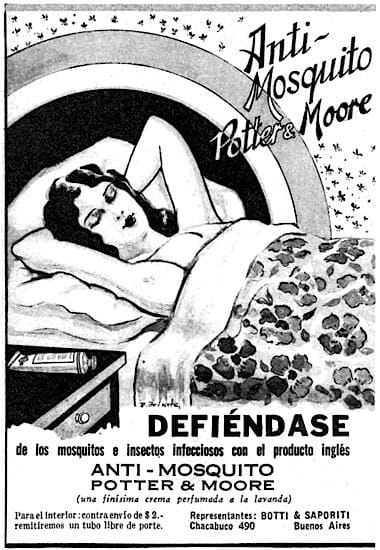
1932 Potter & Moore Anti-Mosquito Crema (Argentina).
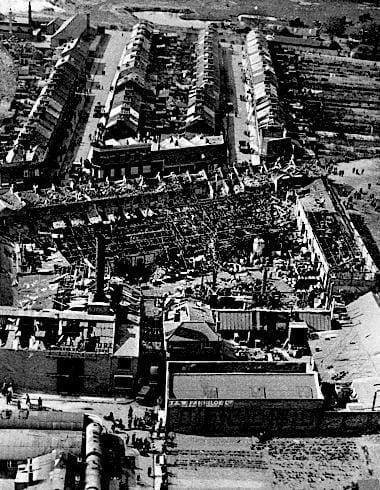
1933 Chemical works of J. W. Bush & Co. in Batsworth Road, Mitcham after the explosion.
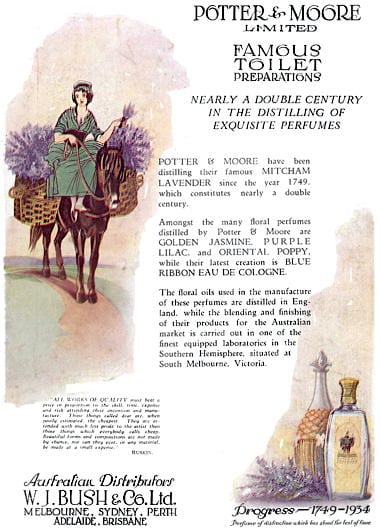
1934 Potter & Moore (Australia).
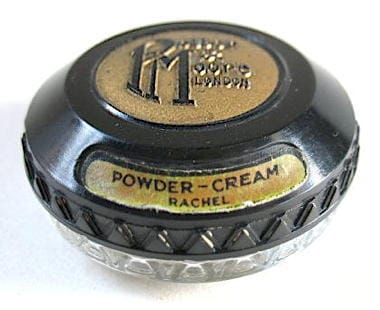
Potter & Moore Mitcham Lavender Powder-Cream in a redesigned container.
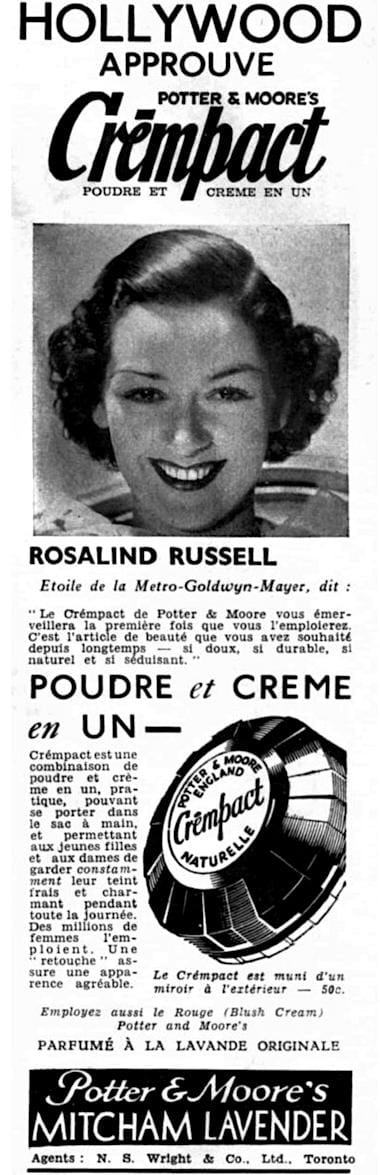
1936 Potter & Moore Crémpact (Quebec, Canada).
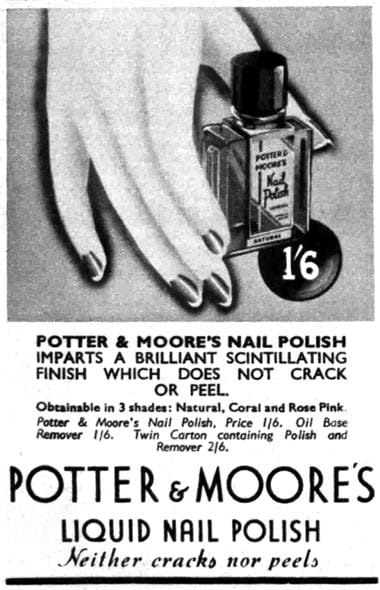
1937 Potter & Moore Liquid Nail Polish.
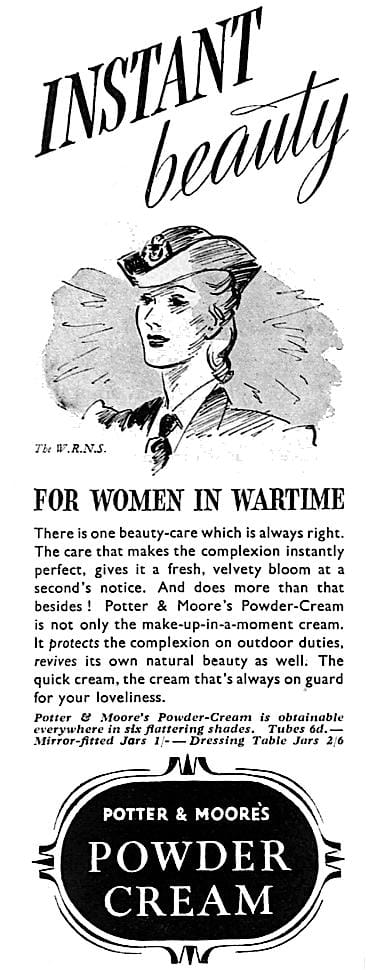
1940 Potter & Moore Powder-Cream.
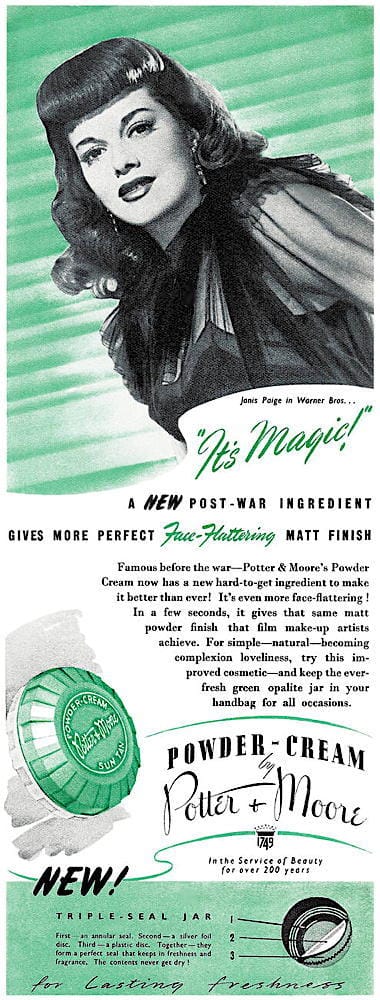
1949 Potter & Moore Powder-Cream.
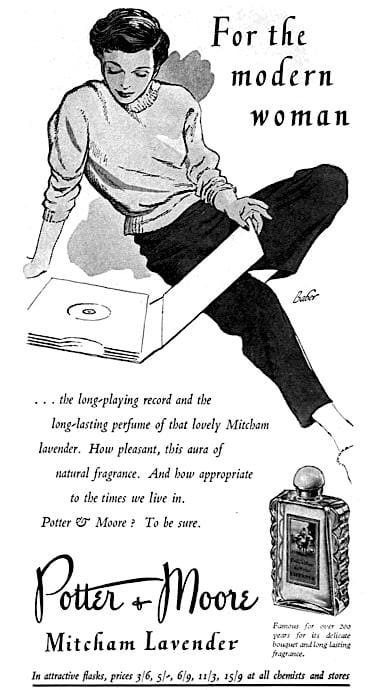
1954 Potter & Moore Mitcham Lavender.
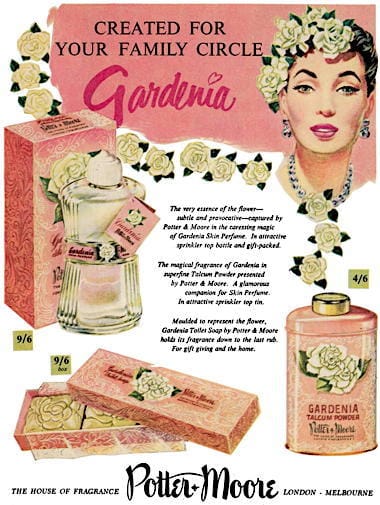
1955 Potter & Moore Gardenia Series (Australia).
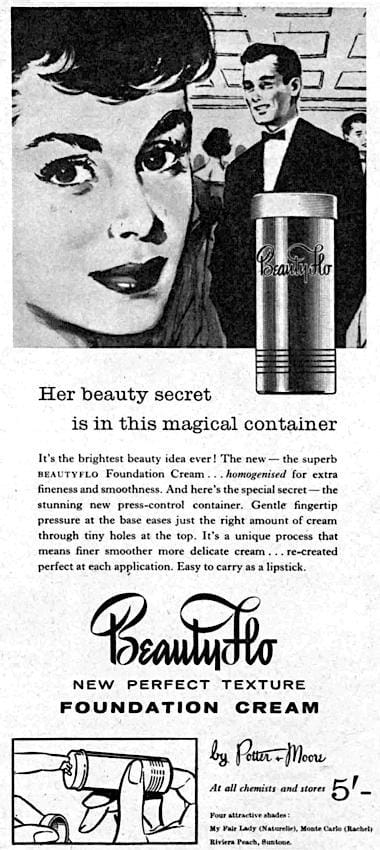
1958 Potter & Moore BeautyFlo Foundation Cream.
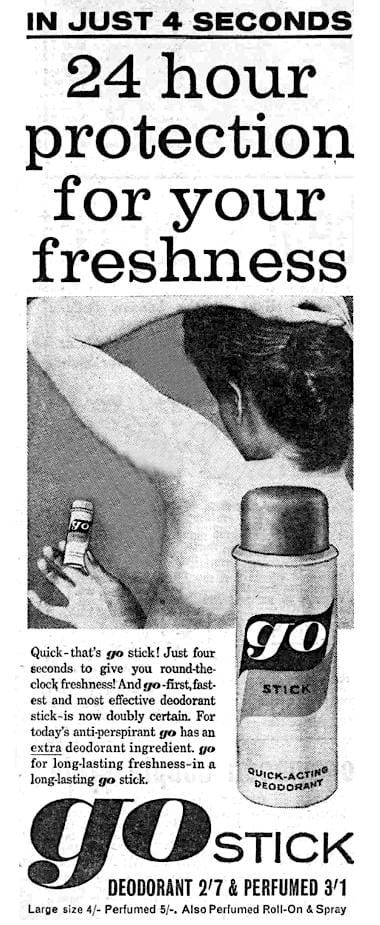
1962 Go Stick Deodorant.