
William A. Poucher
William Arthur Poucher was born in Horncastle, Lincolnshire, England to John Poucher [1857-1920], a merchant clerk, and Rachel Poucher, née Dixon [1862-1943]. He was later joined by a sister, Clara Poucher [1894-1983], and a brother, Charles Herbert Poucher [1897-1984].
Poucher grew up in the modest family home at 22 Queen Street, Horncastle, attending school, first at the Wesleyan Day School, then at the Queen Elizabeth’s Grammar School. In 1908, he sat for and passed the College of Preceptors 2nd Class Certificate examination which allowed him to register as a student of the Pharmaceutical Society. This was a necessary prerequisite for his four-year apprenticeship with Carlton & Sons, chemists and photographers, with a shop at 8 High Street, Horncastle. In 1912, after completing his apprenticeship, Poucher enrolled at the Bath and West of England College of Chemistry and Pharmacy, graduating as a Pharmaceutical Chemist (Ph.C.) and Member of the Pharmaceutical Society (M.P.S.) in 1913.
Now qualified, Poucher gained employment with Allen & Hanbury, Ltd., pharmaceutical chemists of Lombard Street, London. However, he also attended lectures with the idea of becoming a doctor. When the First World War broke out in 1914, he joined the Royal Army Medical Corps (RAMC), was commissioned a Lieutenant Quartermaster with the RAMC in 1915, and sent to France. He became a field pharmacist in the 41st Casualty Clearing Station on the Western Front where he gained the nickname Walter.
Poucher’s experiences with the RAMC made him very critical of the Army’s pharmaceutical service, particularly the use of unqualified personnel, and he made a number of suggestions, during and after the war, to the War Office on ways to improve the dispensing of medicines most of which fell on deaf ears.
In 1919, with the war now ended, and Poucher now a captain, he married Hilda Mary Coombes [1891-1924]. They had a son, John Bernard Poucher [1920-2007] the following year. Unfortunately, Hilda died in stillbirth in 1924. Poucher would marry again in 1937. His second wife, Elsie Dorothy Wood [1899-1988], had previously been his housekeeper.
Ucal
The horrors of trench warfare had cured Poucher of any desire to go into medicine so he took up a position as works manager with the United Chemists’ Association, Ltd. (Ucal) in 1919. Ucal was a cooperative founded in 1909 by a group of pharmacists in Sheffield. It produced a wide range of proprietary products, including cosmetics, which were distributed to its growing number of member chemists across the British Isles. After outgrowing its factory in Sheffield, Ucal had moved to a new facility in Priory Court, Cheltenham in 1912, and is where Poucher was based.
The wide range of products produced by Ucal would have given Poucher valuable skills in formulation and it is while he was there that he wrote his first book ‘Perfumes and cosmetics, with special reference to synthetics’. Printed in 1923 by Chapman & Hall, Ltd., with a dust jacket and cover design by Olive Shaw, it was quickly republished in the United States.
Perfumes and cosmetics
‘Perfumes and cosmetics, with special reference to synthetics’ was divided into three sections: Raw Materials, Perfumes, and Cosmetics.
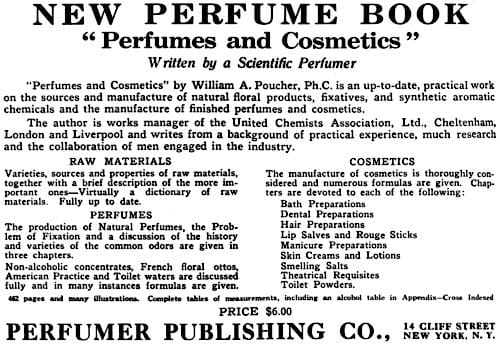
Above: 1923 “Perfumes and Cosmetics” by William A. Poucher (USA).
The single-volume book received wide attention and was generally praised.
The distillation of essential oils and the manufacture of synthetic, odoriferous products are nowadays important branches of the fine chemical industry, and chemists engaged in such work may be interested in finding out from Mr. Poucher’s pages how their comparatively crude products are converted into the highly decorated articles which fill the windows of perfumers, hairdressers, and drug stores.
(Nature, 1924, 113, p. 780)
This book is to be commended not only to those engaged in the manufacture of perfumes and toilet articles, but to the pharmacist who wants information on various subjects relating to these materials. There are, as we have said, many formulas for the numerous preparations named in the book, but more than these, there are many suggestions which should prove helpful to the trade in general.
(The Pharmaceutical Era, 1924, May, p. 532)
A second, two-volume edition, now titled ‘Perfumes, cosmetics & soaps: With special reference to synthetics’, also published by Chapman & Hall, appeared in 1925. This revised and expanded the content and separated it into two, the first volume being Raw Materials, the second Perfumes and Cosmetics. Later editions followed with the fifth edition (1936) being the first to divided the book into three, with Cosmetics now getting its own volume.
Poucher went on to write numerous articles for trade journals including ‘American Perfumer & Essential Oil Review’, ‘Chemist & Druggist’, ‘The Pharmaceutical Journal’, and ‘The Soap Trade Review’ along with a number of interviews and pieces for various newspapers.
Honours
The importance of Poucher’s writings to cosmetic chemistry can perhaps be best seen in the honours he received. In 1954, Poucher was the first foreigner to receive the Medal Award of the American Society of Cosmetic Chemists, later known as the Maison G. deNavarre Medal Award, the society’s highest honour. He was also made an honorary member of the society in 1956, having previously been made the first honorary member of the Society of Cosmetic Chemists of Great Britain in 1952.
See also: Maison G. deNavarre
Eve’s Beauty Secrets
Following the publication of the first edition of ‘Perfumes, and cosmetics’, Poucher resigned from Ucal and took up a position as managing director of R. F. White, Ltd., a London company that manufactured toilet soaps and perfumes. He was not there for long, setting up on his own as a consulting perfume-chemist at Victoria Station House, 191 Victoria Street, Westminster in 1923, moving to The Laboratory, London Road, Mitcham in 1928, and 17 Woodstock Street, London in 1929.
During this time, Poucher produced a small book on cosmetics aimed at the general public, ‘Eve’s Beauty Secrets’ with illustrations by Olive Shaw, also published by Chapman & Hall. Arriving in 1926, it included many of the ideas then held by Beauty Culture outlined in clear language, offering useful beauty advice in many instances. Unfortunately, it also endorsed a number of common misconceptions then circulating. For example, Poucher claimed that relaxed muscles could be tightened with astringents thereby reducing wrinkles, that skin foods were necessary to feed the skin, and that starch in face powders should be avoided as the powder particles would expand when moist, blocking and enlarging the pores of the skin.
Yardley
One of firms that engaged Poucher as a consulting perfume-chemist was Yardley & Co., Ltd. After solving a problem for them in 1929 they invited him to join the firm on a permanent part-time basis. Yardley had previously relied on French perfumers for their fragrances so this was a first for them. After disposing of his consulting business, Poucher began working for Yardley in 1930 and remained with them until he retired in 1959.
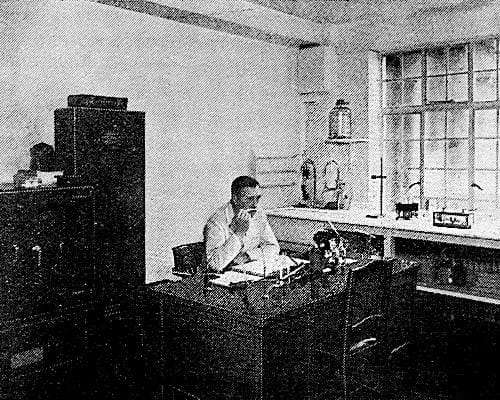
Above: 1934 Poucher in his research laboratory at Yardley.
Perfume historians have generally ignored Poucher but it seems likely that he played a part in the development and/or reformulation of a number of Yardley perfumes including Orchis (1931), Elegance (1932), Bond Street (1936), Flair (1950), and Lotus (1957) as well as their accompanying cosmetics. Thanks to synthetics the mid-price of these perfumes made them available to the growing middle class, Yardley’s main customers. Of the perfumes, the Bond Street series, which included a perfume, toilet water, dusting powder, face, powder, compact powder, make-up base, and lipstick, appears to have been the most successful. At Poucher’s retirement dinner, the chairman of Yardley paid particular attention to it.
[I]t was Poucher who had created Bond Street perfume—the only English perfume of international reputation and the best perfume that has ever born the name of Yardley. Bond Street is unique in being created by an Englishman and being sold throughout the world by an English House.
(Yardley newsletter, 1960)
Also see the Yardley booklet: Beauty Secrets from Bond Street (1937)
I assume Poucher also participated in the creation of a number of new Yardley cosmetics including Liquefying Cleansing Cream (1936), English Complexion Powder (1937), Make-up base (1942), Feather Pressed Powder (1950), and Vitamin Night Cream (1954).
Poucher also played a part in the development of the English lavender industry in Fring, Norfolk, conducting tests of its first commercial harvest in 1936 which included a visit from Queen Mary [1867-1953]. Yardley was intimately associated with products made from lavender and its advertisements gave the impression that its source of lavender oil was English. However, most of the oil was imported from France. It was hoped that the cultivated lavender from Fring would allow Yardley to reduce its dependance on oil from French wild-picked lavender. Following an expansion of the lavender fields there, Fring became a major source of lavender oil for Yardley and lavender is still grown there today.
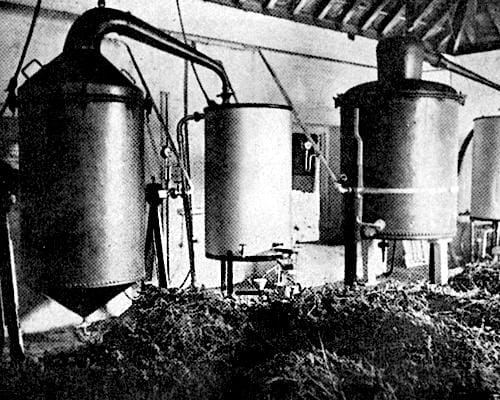
Above: Yardley distillery at Fring, Norfolk from a photograph taken by Poucher.
See also: Yardley
Guide books
Poucher only worked part-time for Yardley and this gave him ample time to pursue his other interests in mountain walks and photography. He became a member of The Royal Photographic Society of Great Britain in 1940 and The Climbers’ Club in 1945.
Poucher combined his notes and photographs from his walks into books, initially published in black and white but later in colour. The first of these was ‘Lakeland through the Lens’ published by Chapman & Hall in 1940. Additional titles that covered most of the mountainous regions of Great Britain and made him better known for them than for his services to cosmetic chemistry. However, when interviewed on ‘The Russell Harty Show’ (BBC, 18th November, 1980), Russell Harty [1934-1988] appeared to show more interest in Poucher’s cosmetics than his photography .
Above: 1980 The Russell Harty Show featuring Grace Jones, W. A. Poucher and Patrick Lichfield.
Legacy
When reviewing Poucher’s influence on the cosmetic industry, it is worth comparing his book with ‘The preparation of perfumes and cosmetics’ by J.-P Durvelle which also appeared in 1923. Translated from the French by Ernest J. Parry, Durvelle’s book did included a dictionary of the known synthetics and gave some suggestions on how they could be used but relied mainly on conventional methods and materials. As Maurer (1958) noted, Poucher’s book heralded a more integrated approach to the use of natural and synthetic ingredients that would be applied from then on.
[O]ur present familiarity with the liaison between natural and artificial perfumery materials may be definitely traced to the advent of the single volume first edition, in 1923, of W. A. Poucher’s now world-famous treatise upon “Perfumes, cosmetics and soaps.”
(Maurer, 1958, p. 38)
With his background in chemistry, Poucher also promoted using more analytical methods, backed by rigorous scientific testing, to the formulation of perfumes and their associated cosmetics. As Dr. Everett G. McDonough [1905–1992], a previous recipient of the Medal Award of the American Society of Cosmetic Chemists, noted in 1955, “[Poucher] stands out as the one who has done more than anyone else in England in gaining recognition of the need for scientists and the use of scientific methods in the cosmetic industry”.
First Posted: 12th March 2026
Last Update: 20th March 2026
Sources
The American perfumer & essential oil review. (1906-1955). New York: Robbins Perfumer Co. [etc.].
Bouillette, P. L. (1955). William A. Poucher, the pioneer. The Journal of the Society of Cosmetic Chemists. VI(1). 69-74.
The chemist and druggist. (1859-). London: Morgan Brothers.
The drug and cosmetic industry. (1932-1997). New York: Harcourt Brace Jovanovich [etc.].
Lorimer, H. (2015). Standards of beauty: Considering the lives of W. A. Poucher. GeoHumanities, 1(1), 51-79.
Maurer, E. S. (1958). Perfumes and their production. London: United Trade Press.
Poucher, W. A. (1926). Eve’s beauty secrets. London: Chapman & Hall, Ltd.
Poucher, W. A. (1932). Perfumes, cosmetics and soaps (4th ed., Vols. 1-2). London: Chapman & Hall, Ltd.
Smith, R. (2008). A camera in the hills: The life and work of W. A. Poucher. London: Frances Lincoln.
W. A. Poucher awarded S.C.C. Medal. (1955). American Perfumer & Essential Oil Review, January, 27.
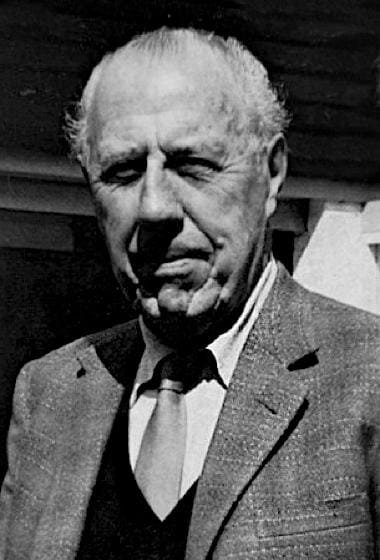
William (Walter) Arthur Poucher [1891-1988].
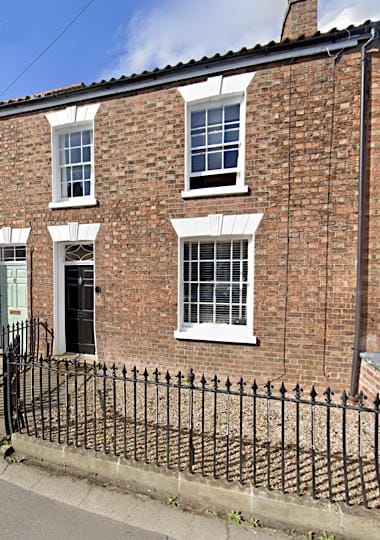
22 Queen Street, Horncastle. The building is listed so was probably similar to this when it was the Poucher family home.
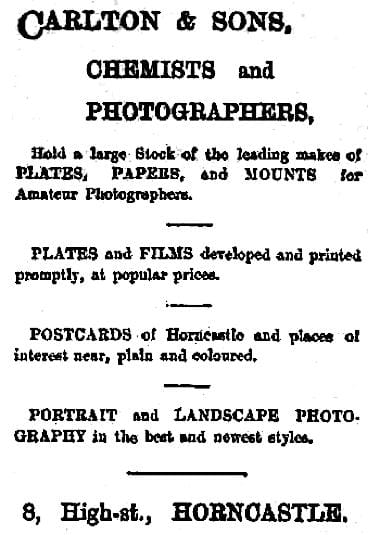
1913 Carlton & Sons, Chemists and Photographers.
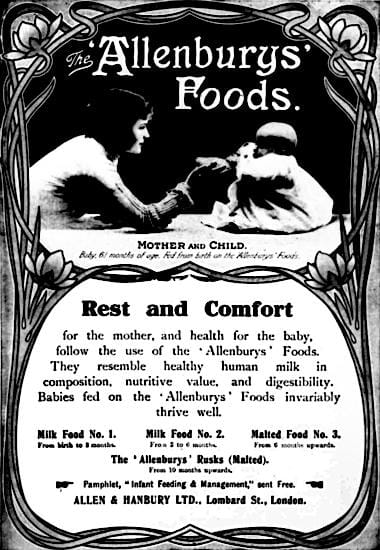
1913 Allen & Handbury, Ltd.
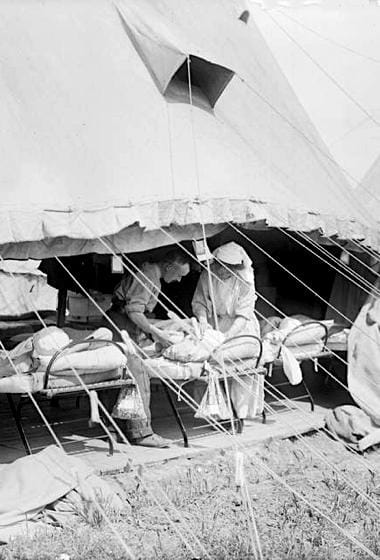
1916 A doctor and a nurse tending to patients in a tented ward of a Casualty Clearing Station near Vaux, France (Imperial War Museum).
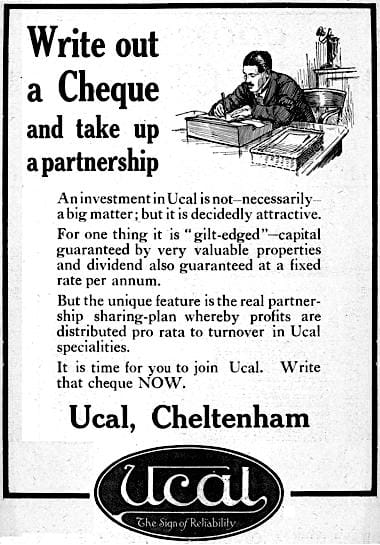
1919 Ucal, Cheltenham.
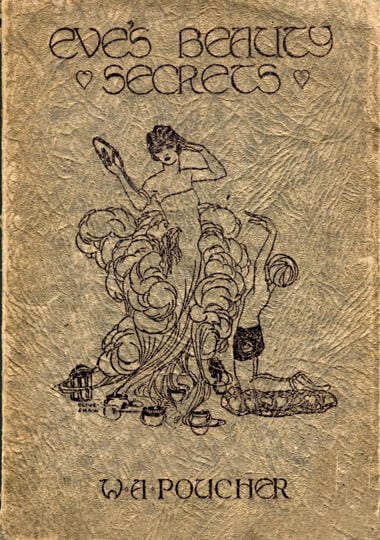
1923 Cover from Eve’s Beauty Secrets.
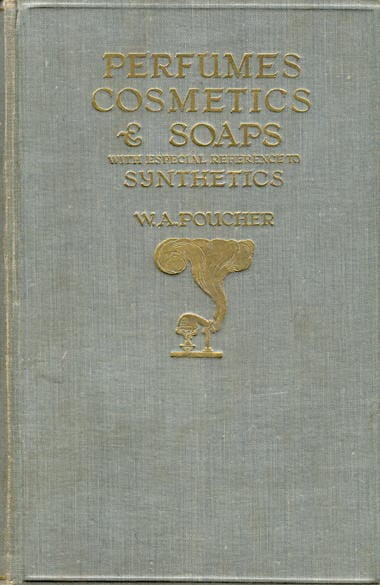
1930 Perfumes Cosmetics & Soaps, Volume 1 (3rd Edition). The cover and missing dust jacket was designed by the artist and botanical illustrator Olive Shaw a.k.a Margaret Olive Milne-Redhead [1904-1997]
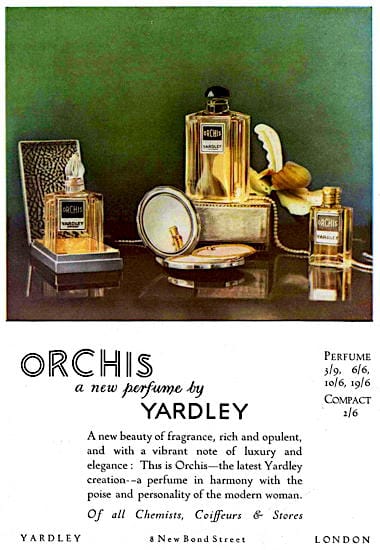
1931 Yardley Orchis.
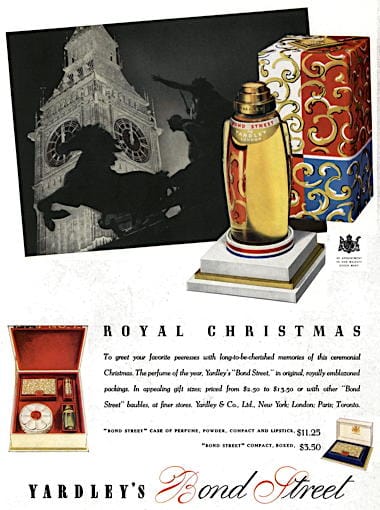
1937 Yardley Bond Street.
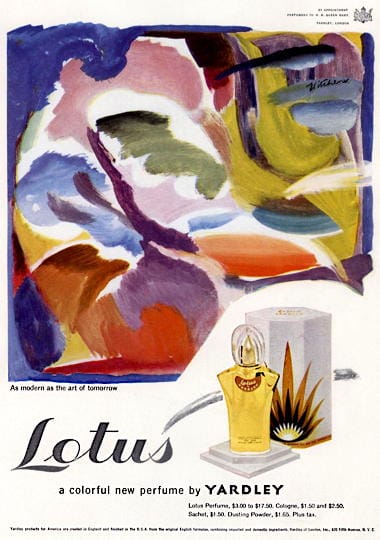
1949 Yardley Lotus (USA).
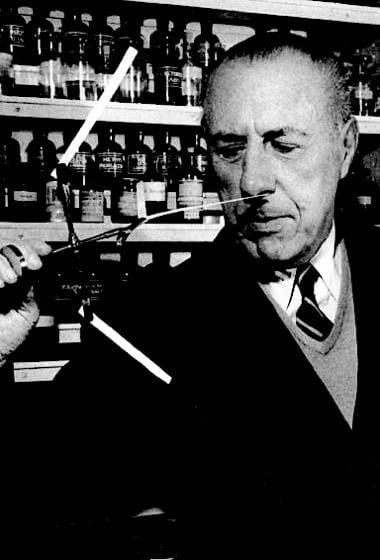
1954 William A. Poucher.
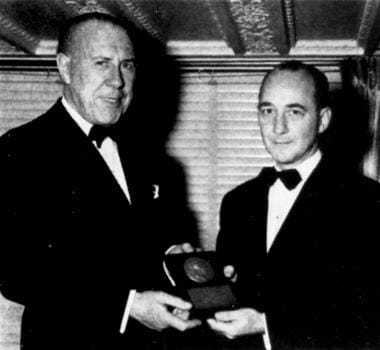
1965 W. A. Poucher accepting the annual medal award from Dr. Kenneth L. Russell, president-elect of the Society of Cosmetic Chemists.
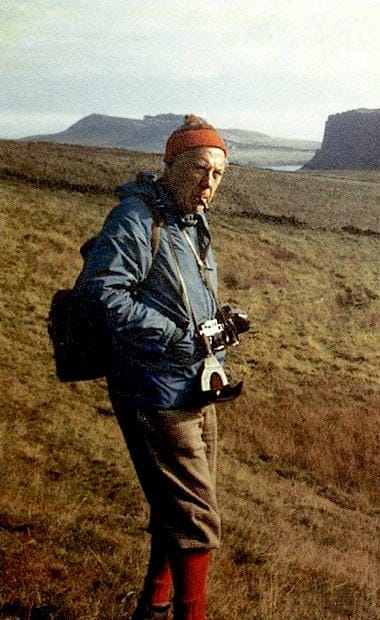
W. A. Poucher in the Scottish Highlands with his Leica camera. He is smoking a cigar.