
Ingredients Lists
Deciphering an ingredients list on a cosmetic can be very useful. It can help you:
- determine how the product is likely to function;
- ascertain the source of the ingredients;
- examine the claims made for it by the manufacturer; and
- avoid potential irritant or allergic reactions.
Today, most countries have legislation in place that requires manufacturers to include an ingredients list somewhere on their cosmetic products. Although the legislation differs between countries, generally speaking the requirement is to list the ingredients clearly and legibly in descending order of quantity. There are variations to this general rule in the different jurisdictions including:
- Samples, testers as well as salon only products that are only used by professionals generally do not include an ingredients list.
- Products such as nail polish that come in a wide variety of shades may be able to list all the colours under used in the entire product line under the title ‘May contain’.
- Fragrances and perfumes (which are complex formulations) may be listed simply as ‘fragrance’ or ‘perfume’.
- Products that contain ingredients that are ‘trade secrets’ may be allowed to leave them off the label if the list ends with ‘other ingredients’.
- Additional warnings may be added to products that contain ingredients where misuse could be hazardous, e.g., aerosols, depilatories, and flammable products.
- Some ingredients lists are only available in the store where the cosmetic is purchased.
Despite the general similarities in ingredients list labeling, there are differences between regulatory jurisdictions that you should be aware of if you are purchasing cosmetics online, by mail order, or on holiday.
- Ingredients allowed in cosmetics may differ from jurisdiction to jurisdiction. For example, Japan, the European Union (E.U.) and the United States (U.S.A) disagree on allowable colours.
- The E.U. allows the marketing of some cosmetics with known medicinal effects that are classified as drugs in other jurisdictions. If you live outside the E.U. you should take this into account.
- The degree of policing varies between jurisdictions. Places where regulation is lax may mean that toxic ingredients are present in the cosmetic either by deliberate addition or as contaminants, eg. mercury.
See also: Mercolized Wax - Words such as natural, organic, fragrance free, preservative free and hypoallergenic have no agreed definitional standards and should be treated with some degree of skepticism when applied to ingredients.
- The legal definition of cosmetic varies from country to country. Some products you might think of as being a cosmetic, may in fact be treated as over the counter (OTC) drugs in some countries and therefore would not be required to have a full ingredients list.
See also: What is a cosmetic? - China currently requires animal tests for cosmetics products sold there, whereas other jurisdictions have banned it.
Deciphering the ingredients list
Unlike a therapeutic good (drug), a cosmetic is not one active ingredient in a base, but rather a complex formulation of numerous substances contributing to an overall effect. When trying to determine what is in a cosmetic you face a number of problems:
- The chemical names of most ingredients are generally unfamiliar and require decipherment.
- There is currently no agreed method of identifying an ingredient and many are listed by one of several names. ‘Palm Oil’ for example can also be called ‘Palm Butter’ or ‘Palm Tallow’. Also, the E.U. tends to prefer latinised names whereas the U.S. uses Standard English terms – ‘paraffinum liquidum’ in the E.U. is ‘mineral oil’ or ‘liquid paraffin’ in the U.S. The E.U. also uses a different numbering system to the U.S. for identifying colours.
- There are tens of thousands of ingredients that can be used in cosmetics which makes it difficult to ‘read a label’ at the place of purchase.
- Some ingredients have more than one function in a product. This makes them particularly good for cosmetic chemists but can make it difficult to determine their role in the cosmetic. It can also lead to claims for the product which, although ‘factually true’ are marginal at best. For example, tocopherol (Vitamin E) may be advertised as a ‘skin vitamin’ when, in fact, its primary use in a cosmetic is as an antioxidant.
- The same ingredient can have different functions in different products. Titanium dioxide, for example, may be used as a whitening agent in a powder but be incorporated into a cream primarily to protect the skin against UV radiation.
Difficult but not impossible
Like all things, reading ingredients lists gets easier with practice; start with products you use regularly. In order to determine the function of a cosmetic ingredient you are going to need a good reference source such as Winter’s “A Consumers Dictionary of Cosmetic Ingredients” or search online. Fortunately, the introduction of the International Nomenclature of Cosmetic Ingredients (INCI) means that most of the more chemical sounding ingredients listed have been standardised. There are a number of places online where you can get INCI lists of the more common cosmetic ingredients along with their function. A good place to start would be www.cosmeticINFO.org, a site maintained by the Personal Care Products Council (PCPC) – formerly the Cosmetic, Toiletries and Fragrance Association (CFTA).
Unfortunately, many manufacturers make it difficult to find their ingredients online. Those that only provide lists of ingredients at the point of sale are best photographed should you wish to take the list home.
Even with the list and a good reference at hand, it can be hard to make sense of all the ingredients listed in a cosmetic. One process that might help is to classify each ingredient according to function. By doing this you can see how the product ‘works’, as well as understand which ingredients form the active part of the product (e.g. moisturisers, emollients) or are part of the over-all formulation (e.g. preservatives, anticaking agents, emulsifying agents).
Cosmetic Active Ingredients: these ingredients are necessary if the product is to do its job. For example, skin-care products generally contain an emollient to make the skin feel smooth and soft. The emollient would be the cosmetic active ingredient.
Assist the Cosmetic Active Ingredients: these ingredients are necessary if the product is to work properly. They include:
- solvents used to dissolve the active ingredients;
- binding agents such as gums, fats or waxes which hold the product together;
- foaming agents;
- chelating agents which remove unwanted metals that can cause product spoilage;
- surfactants and emulsion stabilisers which stop oils/fats and water from separating;
- texturisers which help the product feel right;
- thickeners which stiffen a thin product thereby making it appear richer;
- plasticisers which keep a product flexible and stop it from cracking;
- film formers which help a product form a thin film;
- colours which make products look more appealing. Some colours are also regarded as opacifiers – these make the product less translucent or give it a pearlescence;
- fragrance to disguise the smell or taste of some ingredients and/or to make the product more appealing;
- antioxidants to help stop colour changes in the product and prevent it from going rancid; and
- preservatives which inhibit the growth of microbes (bacteria and fungi).
It is also worth remembering that things at the front of an ingredients list make up a higher proportion of the product than ingredients at the end of the list.
Skin-care products
Ingredient lists of skin-care products are of particular interest, due to their ‘anti-ageing’ and moisturising claims. These claims are sometimes associated with strange-sounding ingredients often using made up names. Needless to say it is hard to estimate their effectiveness without knowing what they are.
Some things to think about when looking at the ingredients and the advertising claims of skin-care products are:
- Humectants are often used to give a moisturising claim for a product when their main role may be to stop the product drying out on the shelf. Humecants are often added to bread and cake for similar reasons.
- Antioxidants claims in skin-care products are often associated with the presence of vitamins, such as vitamin E. However, the main beneficiary of the antioxidant may be the product not your skin – antioxidants are preservatives, they stop product spoilage.
- As a general rule, cosmetics that contain more ‘natural’ ingredients tend to require higher levels of preservatives than those based on petroleum products.
- Petroleum-based cosmetics tend to have lower allergy and irritant rates.
- Anti-ageing claims are usually associated with the presence of a sunscreen. For example, adding titanium dioxide or zinc oxide to a product can allow a manufacturer to make an anti-ageing claim.
- Just because a compound is used in something else that sounds bad, this does not mean that it should be avoided. Urea, for example is used in fertiliser; however, it is also produced by the body and is one of the skin’s natural moisturising factors (NMFs). NMFs help the skin to hold on to water in its horney layer, the stratum corneum.
Are cosmetics safe?
One of the main reasons you might be interested in what is in your cosmetics is to help you determine how safe they are. The web contains a number of sites listing ‘dangerous cosmetic ingredients’ that are supposed be avoided, many of which are spurious.
Although we know relatively little about the long-term effects of many cosmetic ingredients, this should not make you think cosmetics are inherently unsafe. Trade organisations such as the Personal Care Products Council (PCPC), formerly the Cosmetic, Toiletries and Fragrance Association (CFTA) have a vested interest in ensuring that ingredients are safe, if only to avoid being more heavily regulated. Statistics show that cosmetics are one of the safest products you can buy, as long as you purchase them from a jurisdiction with appropriate regulations and trade associations in place – something to think about when you are purchasing products online.
Updated: 7th September 2017
Sources
Kennedy, J. (2014, January 19). Ingredients of an all-natural passionfruit. James Kennedy. Retrieved September 7, 2017, from https://jameskennedymonash.files.wordpress.com/ 2014/01/ingredients-of-an-all-natural-passionfruit-poster.jpg
Winter R. (2005). A consumers dictionary of cosmetic ingredients (6th. ed.). New York: Three Rivers Press.
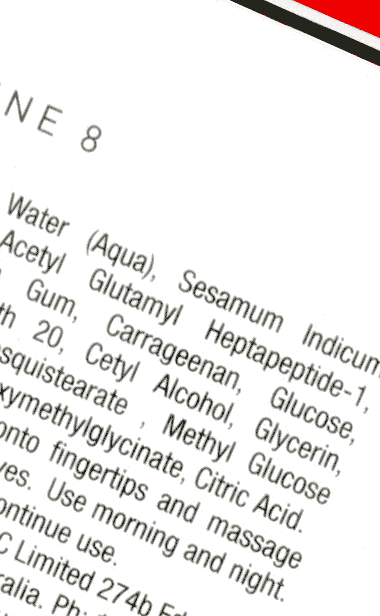
An example of a cosmetic ingredients list. Some names seem familiar others not.
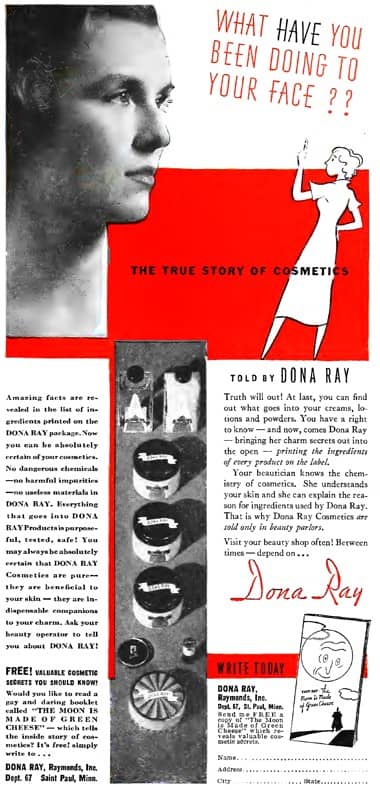
1936 Dona Ray Cosmetics. An early example of a company that included a list of ingredients on their product labels.
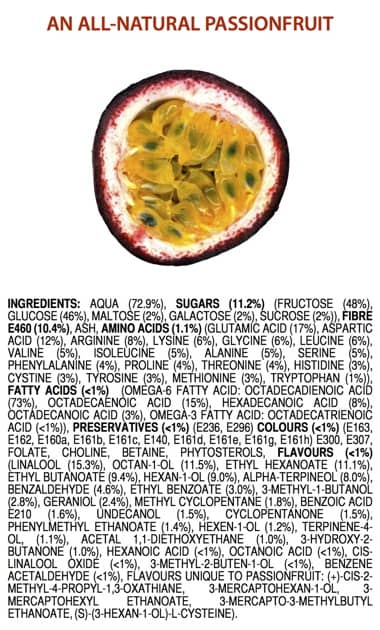
Ingredients in cosmetics can look scary but so can those found in natural products such as passionfruit (James Kennedy).