
Mascara
Until the late nineteenth century, any woman wanting to darken their eyelashes had to dye them, use kohl, or resort to one of the many recipes in circulation for making up something at home.
Take an ounce of frankincense, the same quantity of rosin and pitch, and half as much mastic. Throw all these ingredients upon a piece of red-hot charcoal, receive the fumes into a large funnel, and a fine black powder will adhere; mix this with a little oil of Benjamin, Eau de Cologne, or what is perhaps better, the juice of elder-berries, and it is fit for being applied to the eye-lashes or to the eye-brows.
(‘Beauty of the eyes,’ 1824)
See also: Kohl
What would turn out to be an important addition to the list of eyelash darkeners was a product originally known as a water cosmetique, made by milling black or brown pigments into soap. Like greasy cosmetiques, water cosmetiques were used to fix hair in place with pigmented versions mainly sold to men who used them to temporarily darken their beards, moustaches, and/or sideburns.
See also: Water Cosmetique (Mascaro)
Eugène Rimmel [1821-1887] is frequently credited with inventing water cosmetique. Exactly when he did this is unknown but it must have been before 1855 when he is first mentioned by George William Septimus Piesse [1820-1882] in his book The art of perfumery.
Black and Brown Cosmetique
Such as is sold by RIMMEL, is prepared with a nicely-scented soap strongly colored with lamp-black or with umber. The soap is melted, and the coloring added while the soap is soft; when cold it is cut up in oblong pieces.
It is used as a temporary dye for the moustache, applied with a small brush and water.(Piesse, 1855, p. 208)
The water cosmetique described by Peisse refers to Rimmel’s New Water Cosmetique which was sold in blocks in rectangular boxes rather than as a stick, a form of water cosmetique that Rimmel also manufactured. Even if Rimmel was not the first perfumer to create a water cosmetique, it seems very likely that he was the first maker to packaging it in a box with a brush and mirror.
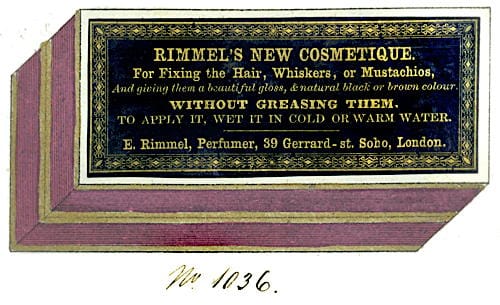
Above: c.1860 Rimmel’s New Cosmetique. The box also contained a small mirror and brush as well as the block of water cosmetique.
See also: Rimmel
Packaging a water cosmetique into a box with a mirror and brush would prove to be extremely significant as it would become the cosmetic that most women would use to darkened their eyelashes for over sixty years. This leads us to ask the question; when did water cosmetique get repurposed as mascara?
In 1933, the French magazine, ‘La Vie Parisienne’, suggested that the first person to use water cosmetique in their eyelashes was the French actress Cécile Sorel [1873-1966], presumably around 1903 when Sorel first played Célimène in ‘Le Misanthrope’ at the Comédie-Française. The magazine extract below from ‘La Vie Parisienne’, outlines this claim but it should be noted that it may not be referring to Eugene Rimmel directly as rimmel is synonymous with mascara in the French language.
Le rimmel
Les femmes, qui emploient le Rimmel pour allonger leurs cils, savent-elles que ce produit fut inventé en 1860 par un parfumeur parisien pour les élégants de l’époque, qui s’en servaient pour faire tenir leurs moustaches. C’est Mme Cécile Sorel qui eut, il y a quelques années, la première, l’idée d’employer le Rimmel pour ses yeux et la Parisienne coquette suivit l’exemple de Célimène.(Trans) The rimmel
Do women, who use Rimmel to lengthen their eyelashes, know that this product was invented in 1860 by a Parisian perfumer for the elegants of the time, who used it to hold their moustaches. It was Madame Cécile Sorel who had, a few years ago, the first idea of using the Rimmel for her eyes and the coquettish Parisian followed the example of Célimène.(On dit, on dit, on dit, 1933)
Cécile Sorel may have been an early user of water cosmetique but it is doubtful that she was the first actress to do so. In all probability, a number of actresses before her had already had the same idea after watching male actors make up.
Mascaro
Water Cosmetique, from Rimmel and other makers, was quickly adopted by nineteenth-century actors to colour their head and facial hair as needed. These actors, and others associated with the profession, also referred to water cosmetique as mascaro but there is no consistency in the usage of the term. William ‘Willy’ Clarkson [1861-1934], a prominent identity in the London theatrical trade, called it water cosmetique.
For pencilling eyebrows nothing is more easily applied or removed than water cosmetique, which is sold in little boxes containing the necessary brush for applying it.
(Fryers, 1904 p. 75)
However, the actor, J. E. Dodson [1856-1931], a British actor who also worked in the United States, referred to it as mascaro.
The lashes are very slightly touch, as a great deal of care is necessary to prevent the [grease]paint from getting into the eyes. Next the eyebrows. For these I use a black water mixture known as mascaro, putting it on with a small, sort of kindergarten, toothbrush.
(Dodge, 1910, p. 21)
As well as sideburns and moustaches, actors also coloured their eyebrows with cosmetique/mascaro but they generally used greasepaint if they needed to colour their eyelashes. Charles H. Fox [c.1839-1893], a London wigmaker and theatrical supplier, mentions using used mascaro on the eyelashes but he was giving advice to amateurs not professionals.
There are various methods for makin up the lashes, and different people will probably find that one suits better than another.
They may simply be darkened by painting them with mascaro, or with warmed black grease paint on a little brush, shaped like a tooth brush, which can be obtained for the purpose.(Fox, 1891)
Being water soluble, water cosmetique/mascaro was easily washed from the hair, while greasepaint required cold cream, cocoa butter, liquid paraffin or some other oily material to remove it. As actors were already using a greasepaint remover to take off the rest of their face make-up it was not a major issue for them to include the eyelashes in the removal process. Also, unlike water cosmetique/mascaro, greasepaint did not run when the actor perspired. It could be very hot working under the new electric lights so this was not an insignificant advantage.
Some nineteenth-century actresses also used greasepaint but many stuck with the older powdered make-up that greasepaint replaced. Like their fellow actors they also used water cosmetique/mascaro on their eyebrows but they extended its use to their eyelashes. Exactly when this occurred is unknown but it was probably well known to actresses by the 1890s. From actresses, water cosmetique/mascaro then found its way into the general population and mentions of it were soon turning up in newspapers reports and beauty advice columns.
Mdlle. Blanche Pierson, the famous French actress, has replied to an impertinently curious correspondent, not with the rebuke which he deserves, but with the information that he asked for. The question was the secret of these beautiful eyelashes by which this societaire of the Comedie Francaise is distinguished. The lady’s reply is, “The recipe is extremely simple. The requisites are—1. Eyelashes. 2. An extremely fine comb. 3. A stick of black cosmetique.” A lady in possession of these means has, we are told, only “to pass the fine comb through the eyelashes after rubbing it with the cosmetique,” et voila! the result is achieved.
(‘Glasgow Evening News,’ 1891)
Please note, the report above suggests that the actress was using a cheaper stick version of water cosmetique, not the block type packaged with a mirror and brush.
There are many different things in the make-up box for eyes and eyelashes—kohl which is very unnatural, and, many black and brown pencils to line the eyes with along the eyelashes. Much care is taken with the eyes, and a magnifying mirror is used to make up by. The eyelashes are painted with Mascaro, a harmless brown or black colouring matter on the end of a little brush.
(‘Lines for ladies,’ 1904)
By the early 1900s, water cosmetique/mascaro was being added to the inventories of Beauty Culturists that were not traditional theatrical suppliers. Mrs. Pomeroy was selling a version by 1905, as was Eleanor Adair by 1906. They were joined by others such as Helena Rubinstein, who introduced her Valaze Tablette Indienne in 1907.
Nothing will make eyelashes a permanent light brown; but “Mascaro,” made by Mrs. Pomeroy … will temporarily darken them. It … is made in three shades—brown, black, and chatain.
(Advice column, 1905)
Ganesh Preparations. — All these emanate from Mrs. Adair … who introduced the strapping technique and the Eastern muscle developing oil. … Her lily sulphur lotion serves the purpose of a liquid powder, and her Ganesh water cosmetic darkens the lashes.
(Adair advertorial, 1906)
See also: Mrs. Pomeroy, Eleanor Adair and Helena Rubinstein
As the century progressed, water cosmetique/mascaro became widely known. Rimmel’s New Cosmetique was a popular choice with women and the term rimmel became synonymous with mascaro on both sides of the British Channel in much the same way that goggling has become synonymous with web searching today.
I have been laughing so that the tears ran down my cheeks after having melted the Rimmel on my eyelashes; that of course made me weep more and more because I really believe that stuff is only soap and indian ink, and when it gets into your eyes it makes you sit up and yell for help I can tell you. Evidently, I quite agree, it would be better to leave my eyelashes to their natural brown state; however, I prefer black, and besides everyone uses some sort of eyelash touch-up. Show me the woman who hasn’t spat into her Rimmel or Mascaro box at some time or other of her life and I’ll buy you a box of tuppenny cigars. When I say spit—only I used the past tense—I mean it. It may not be a pretty gesture but it’s an easy one, and if you’ve ever been inside an actress’s dressing-room in Paris you’ll know what I mean.
(‘Priscilla in Paris,’ 1913)
Choisissez crayons, ou liquides, ou mascaro, ou rimmels, ou kohl, de la teinte réelle de vos cils et sourcils, si vous êtes très blonde, prenez un peu plus foncé, si vos yeux sont noirs prenez très foncé; avoir des cils et des sourcils blonds donne une fadeur au regard. Corrigez cela.
(Nicolle, 1914, p. 34)
Gradually, mascara replaced the terms rimmel, mascaro, and water cosmetique in the English language. However, some of the continental languages held onto rimmel as well. This change largely began in the 1910s. For example, the actress and singer Lillian Russell [1861-1922] used mascara when she began writing health and beauty columns in American newspapers in 1911.
I cannot give you permanent dye for the lashes and brows. Mascara is a good eyebrow and eyelash darkener. You can get it at any drug store. It is not a permanent dye, but a sort of water color.
(Russell, 1912)
In the 1920s, the term mascara became the norm and was also used to describe liquid and cream eyelash darkeners. As these came on to the market cosmetic chemists began to refer to the original water cosmetique/mascaro as a cake or block mascara. All of these different forms have largely disappeared today, replaced by what were originally known as automatic mascaras. The first of these was Helena Rubinstein’s Mascara-Matic which debuted 1957. These ‘wand mascaras’ have become so ubiquitous that they are now simply referred to as mascaras and most women do not realise that there once were other forms.
See also: Cake (Block) Mascara, Liquid and Cream Mascara and Automatic Mascara
First Posted: 29th August 2025
Last Update: 29th March 2026
Sources
Beauty of the eyes. (1824, January 8). Sun, 4.
Dodge, W. P. (1910). “Making up” a successful character actor. The Theatre, January, 20-22.
Fox, C. H. (c.1888). The art of making up for public and private theatricals: advice to amateurs, etc. London: Drake, Driver & Lever, Ltd.
Fryers, A. (1904). A guide to the stage. London: R. A. Everett & Co. Ltd.
Lines for ladies. (1904, March 4). The Shields Daily News, 1.
On dit, on dit, on dit. (1933, January 7). La Vie Parisienne, 625.
Nicolle , R. (1914). Une idée de Parisienne par page.. Paris: Editions Nilsson.
Piesse, G. W. S. (1857). The art of perfumery, and the methods of obtaining the odors of plants, with instructions for the manufacture of perfumes for the handkerchief, scented powders, odorous vinegars, dentifrices, pomatums, cosmetiques, perfumed soap, etc. with an appendix on the colors of flowers, artificial fruit essences, etc. etc. Philadelphia: Lindsay and Blakiston.
Priscilla in Paris. (1913, December 3). The Tatler, 270.
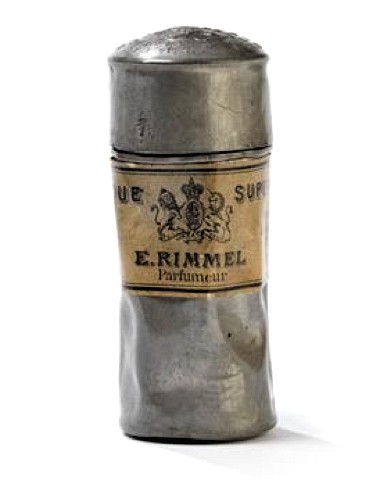
Rimmel Superfin Cosmetique. I have no records of the contents of the aluminium container but it seems likely that it contained a stick of water cosmetique.
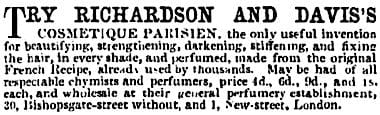
1853 Richardson and Davis Cosmetique Parisian. This may be grease or water based.
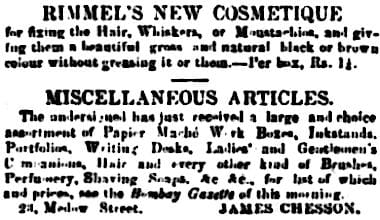
1856 Rimmel’s New Cosmetique (India).
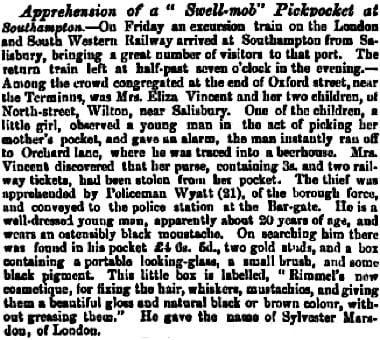
1859 This newspaper report of the takings of a pickpocket indicate that Rimmel’s New Cosmetique was boxed with a brush and looking glass (mirror).
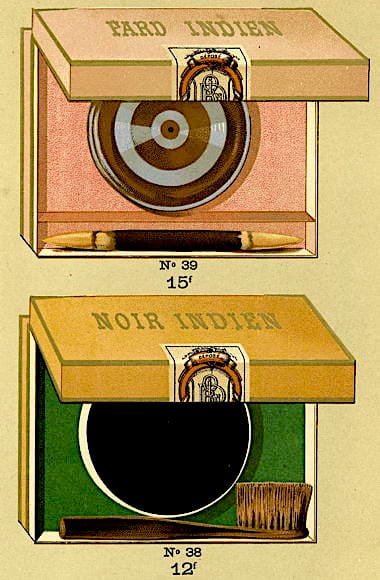
1893 Dorin Fard Indien and Noir Indien. Both came in the same shades: Noir, Brun, Blond, and Châtain. Fard Indien was applied to the eyelashes and eyebrows with a stick; Noir Indien to the hair, moustaches and sideburns with a brush.
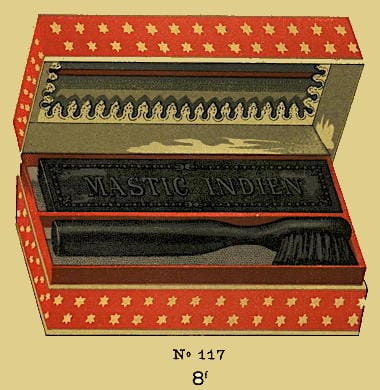
1893 Dorin Mastic Indien applied to the hair, moustaches and sideburns with a brush.
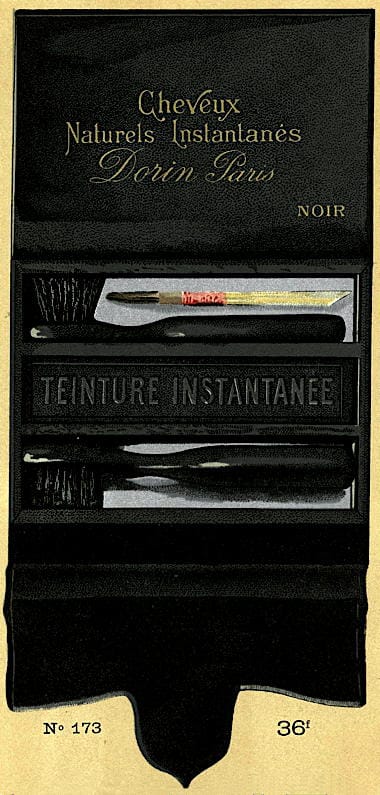
1893 Dorin Teinture Instanee with two brushes and a stick applicator.
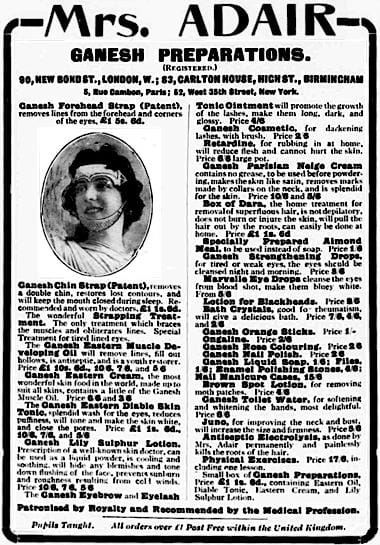
1905 Mrs. Adair Ganesh Preparations including Ganesh Cosmetic.
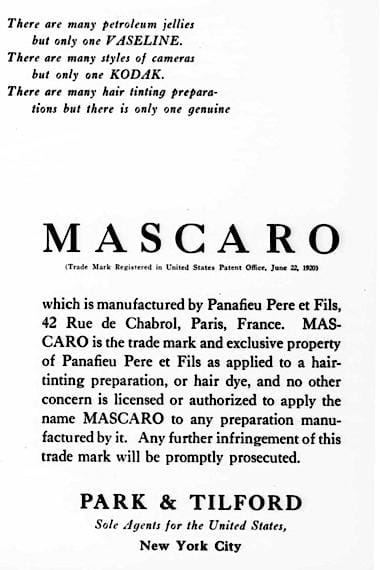
1920 Trade advertisment by Panafieu, Pere et Fils warning others that they owned the mascaro trademark. This may have contributed to the preference for mascara over mascaro.
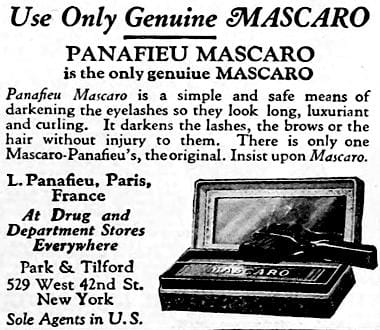
1921 Panafieu Mascaro.
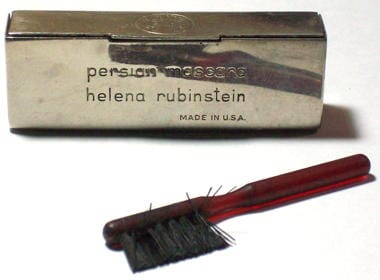
Helena Rubinstein Persian Mascara. Originally introduced as Persian Eyeblack in 1926 which, in turn, replaced Valaze Tablette Indienne.
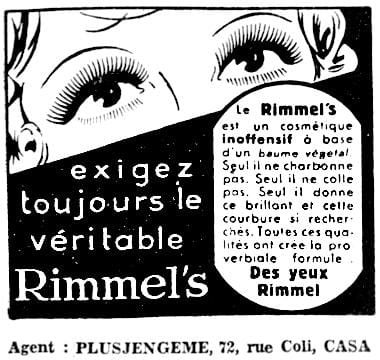
1936 Rimmel’s Cosmetique.
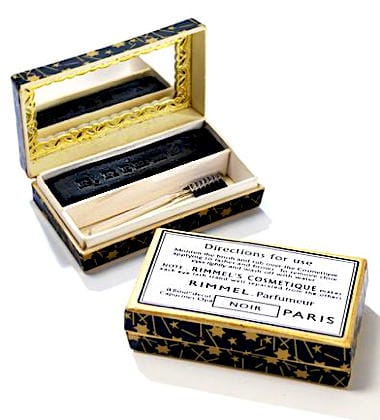
c.1940 Rimmel’s Cosmetique with mirror and brush.
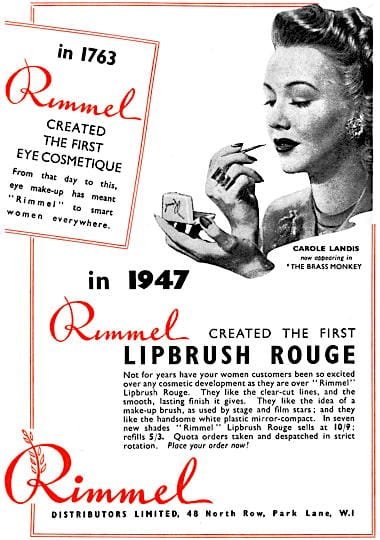
1948 Trade advertisement for Rimmel claiming that they invented the first eye cosmetic in 1763. Rimmel’s father, Hyacinthe Mars Rimmel, who started Rimmel, was not born until thirty years later in 1796.
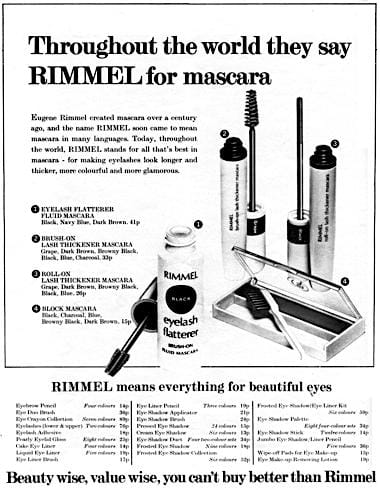
1974 Rimmel Mascara.