
Rimmel
Continued onto: Rimmel (post 1940)
Eugène Rimmel got involved in the perfumery trade through his father, Hyacinthe Mars Rimmel (Rimmel senior) who, in turn, had learnt the business through an apprenticeship with Parfums Lubin, a French company founded by Pierre-François Lubin [1774-1853] in 1798. In 1830, Rimmel senior moved to London to work for Delcroix, a perfumery then based at 158 New Bond Street. Madame Joseph Delcroix had asked Lubin for someone to replace her husband, who had died in 1826, and Lubin suggested Rimmel.
Rimmel senior remained with Delcroix until he opened his own business at 48 Albemarle Street in Piccadilly in 1834 asnd this is usually listed as the founding date for Rimmel. Rimmel senior did not remain there for long, moving to 210 Regent Street in 1835. There is a record of a partnership between Rimmel senior, Louis Jean Baptiste Vaudeau, and Pierre Joseph Gabriel Augustin Bessas being dissolved in 1837. The partnership may have been created when Rimmel senior moved to Regent Street but the 1834 date is also possible. After it declared bankruptcy, its assets were auctioned off by Pullen and Son later in 1837. By then, Rimmel senior had moved on, setting up in business at 39 Gerrard Street, Soho in 1836.
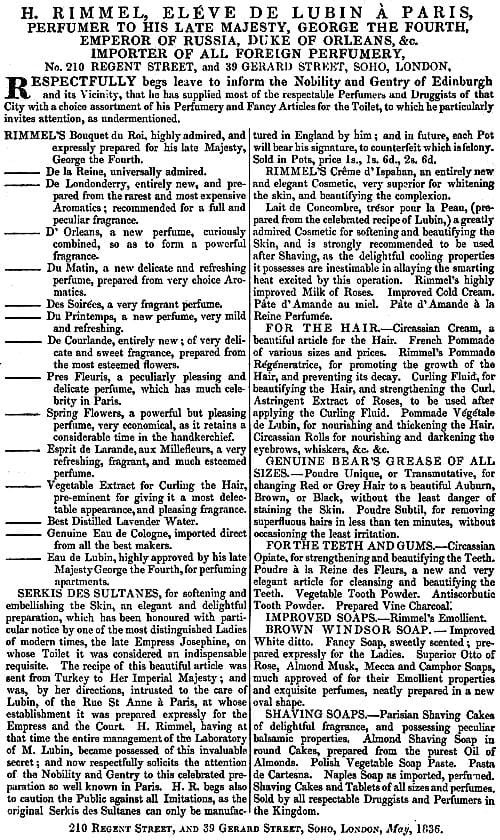
Above: 1836 H. Rimmel.
Eugène Rimmel joined his father in London in 1834, gaining employment with Joseph Marryat & Sons, West Indies sugar merchants, when he was 16. He remained with Marryat for three years, joining his father in Gerrard Street in 1839 or 1840. The father and son went on to form a partnership which was dissolved in 1846 after Rimmel senior retired, moved back to France, and settled in Nice.
Eugène Rimmel continued to operate the business at Gerrard Street – sometimes spelt Gerard Street as it was named after Charles Gerard [c.1618-1694], the 1st Earl of Macclesfield – until he moved to 96 Strand in 1857. By then, Rimmel was widely known after receiving a good deal of publicity for the perfume fountain he created for the Great Exhibition in 1851.
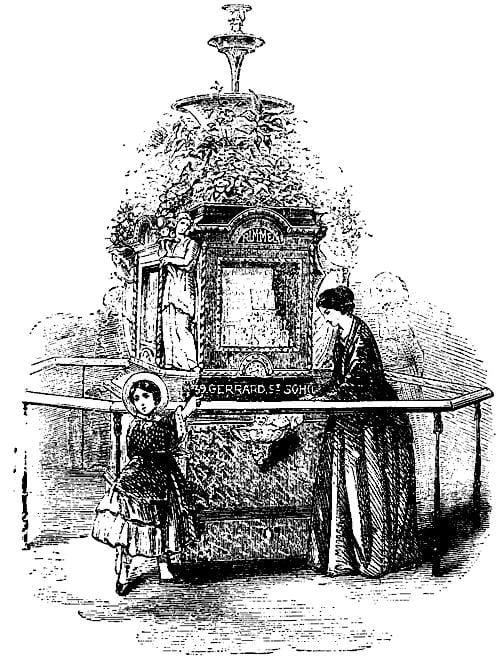
Above: 1851 Rimmel Fountain of Perfume (Floral Fountain) of Rimmel’s Toilet Vinegar at the Great Exhibition held in the Crystal Palace in Hyde Park, London.
Rimmel’s status increased even further after he published his ‘Book of Perfumes’ in 1864, the year he opened a West End shop at 128 Regent Street. This joined a retail outlet at 24 Cornhill Street, which had opened its doors in 1859. An additional shop was opened at 76 King’s Road, Brighton in 1870.
In 1871, Rimmel took possession of Beaufort House which was down the lane from the Strand establishment and used it to house his export department. As many of Rimmel’s products contained alcohol it presumably housed a bonded warehouse. It joined other manufacturing facilities at Neuilly, France and Brussels, Belgium which helped supply Rimmel’s continental depots in Paris, Brussels, Antwerp, the Hague, Amsterdam, and Florence. The Beaufort House building was razed by fire in 1875 but quickly rebuilt.
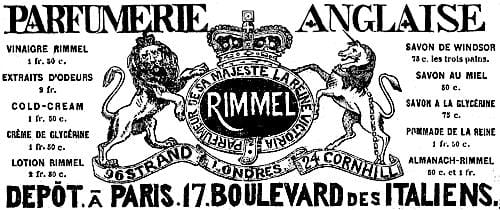
Above: 1861 Rimmel Parfumerie Anglais.
There were also developments in France. Rimmel had opened a depot at 17 Boulevard des Italians, Paris by 1860 but this was moved to a more luxurious store at 9 Boulevard des Capucines in 1880.
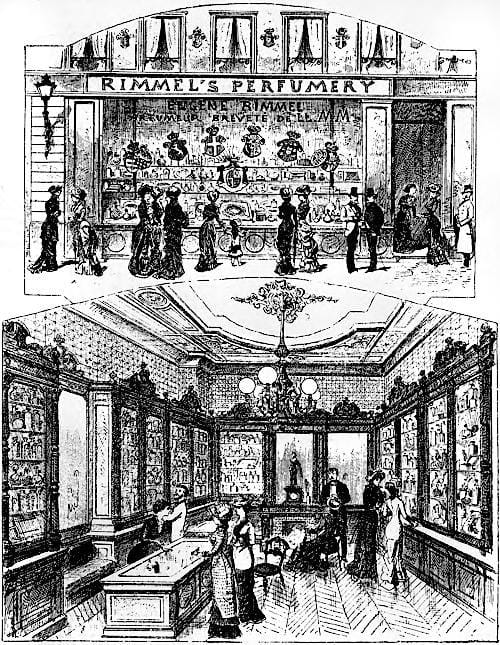
Above: 1880 Rimmel’s Perfumery at 9 Boulevard des Capucines, Paris.
Manufacturing
Rimmel maintained flower gardens and a distillery at 16 Route de Turin, Nice. His father had settle in Nice after he retired so it is possible that he helped establish them. Products from Nice would have been combined with others from Grasse and elsewhere to create Rimmel’s floral fragrances before being shipped through Rimmel’s Export Manufactory at 2, Rue de L’Est, Neuilly. Many of Rimmel’s lines were cheaper to manufacture in France than they were in Britain, even after paying British tariffs and other duties, and this kept the French part of the business busy.
In England, most of the manufacturing was done in the Strand which produced and/or packaged perfumes, soaps and cosmetics. Percy Russell visited the Strand factory and his 1874 account suggests that most of the packaging was done by women but that children were also involved, a common situation in Victorian times.
Comfortably seated at clean deal boards forming a continuous table are rows of quiet, neatly dressed, and in some cases, ladylike looking girls and women. They are all busy with the agreeable chemistry of the toilet. Some, perhaps, pour a cream, which is, possibly, to constitute many fashionable complexions, into bottles; others cork, and others again label them, while children with, as far as I could judge, happy faces, cut out the necessary labels from sheets of a thousand or two.
(Russell, 1874, p.162)
Russell also describes how soap was manufactured by men in the basement before bing passed to women for packaging.
Some of these men kindle fierce fires which generate the all-powerful and pervading steam, others stir in huge caldrons the viscous liquid, or pour it in iron frames whence it is extracted when solidified. Others again cut up the soap into slabs, bars, and cakes in a wonderfully rapid and ingenious manner, and stamp it with a press into curious shapes, after having dried it in a place by the side of which the climate of Ashantee would appear delightfully cool. Then, recourse is had once more to the nimble fingers of women to clothe the soap in attractive wrappers, and arrange it neatly in boxes.
(Russell, 1874, p.162)
In addition to manufacturing perfumes, soaps and cosmetics, Rimmel turned out a large range of paper products, many printed by Rimmel, all scented with Rimmel perfumes. These included almanacs, cards for Valentines Day, Easter, Christmas and other notable occasions along with a wide range on novelties that could be used as gifts.
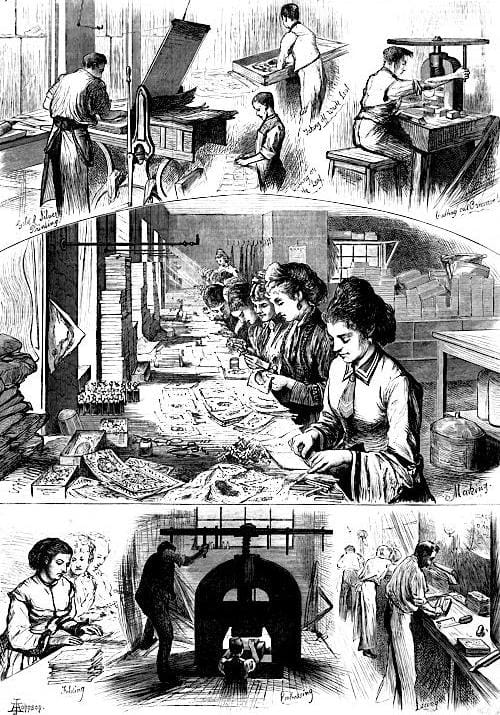
Above: 1874 Men, women and children manufacturing Valentine cards. Some of the more intricate versions cost a guinea or more.
A girl begins with a simple sheet of white paper with a lace border. Her tools are few; scissors, a pair of small steel pincers, a gum bottle and brush, and an abundance of separate sheets of flowers, foliage, and all that you see in the stock-room, suffice to produce what is often the most exquisite of tangible and inarticulate poetry. A rose is attached to the centre, a brooding bird is added, and a framework of blossoms gummed to the edges one by one. In a comparatively small valentine I counted seventy rosebuds, every one being separately fixed—a task that, unless seen, one would say no human fingers could be delicate enough to accomplish.
(Russell, 1874, p.163)
The company also printed scented programs on silk for a number of London theatres. Some theatres also scented their auditoriums with Rimmel perfumes using a Rimmel Aromatic Dispenser which used steam vaporisation to release floral fragrances into the air. Rimmel also recommended these dispensers for disinfecting the air in hospitals, sick rooms and other places after substituting essential oils like rosemary and lavender for the floral fragrances.
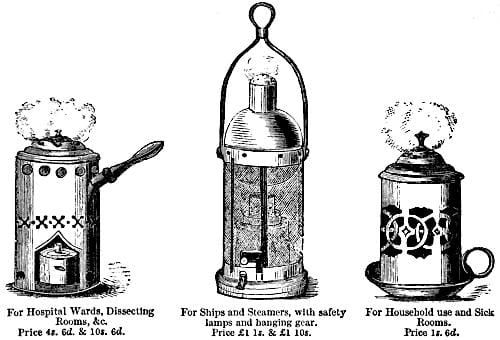
Above: 1862 Rimmel’s Aromatic Dispensers for hospitals, ships and households.
Rimmel’s belief in the disinfecting effect of certain aromatics also led him to develop his Aromatic Ozonizer. This was a powder of coniferous sawdust impregnated with volatile Pine and Eucalyptus aromatic oils. It was placed in a bowl like a potpourri and left to evaporate. Rimmel claimed it generated ozone so was disinfecting as well as bringing a fresh forest fragrance.
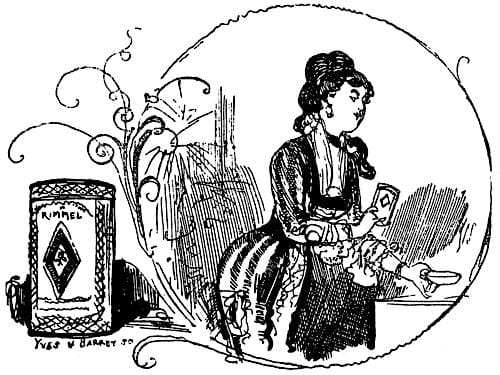
Above: 1878 Rimmel Aromatic Ozonizer.
Cosmetics
Rimmel senior had a number of cosmetics in his inventory including skin softeners and whiteners.
ARTICLES FOR BEAUTIFYING THE COMPLEXION.—Rimmel’s Creme d’Ispahan, an entirely new and elegant cosmetic, very superior for whitening the skin and beautifying the complexion. Lait de Concombre, ésor pour la peau (prepared from the celebrated recipe of Lubin), a greatly admired cosmetic for softening and beautifying the skin. Serkis des Sultanes, used in the Courts of Persia and Turkey, for refreshing and softening the skin: H. Rimmel particularly recommends this article. Rimmel’s highly improved Milk of Roses. Improved Cold Cream. Pâte d’Amande au Miel. Pâte d’Amande à la Reine, parfumée.
(From a Rimmel advertisement, 1837)
Rimmel continued to manufacture most of these but added new items including skin creams, face powders, powdered and liquid rouges, and eye make-up. Like other perfumers, Rimmel also produced cosmetics in different fragrance series. For example, his Tilia fragrance was also used to perfume a soap, toilet water, pomade, hair oil, cosmetique, cold cream, shaving soap, and rice powder.
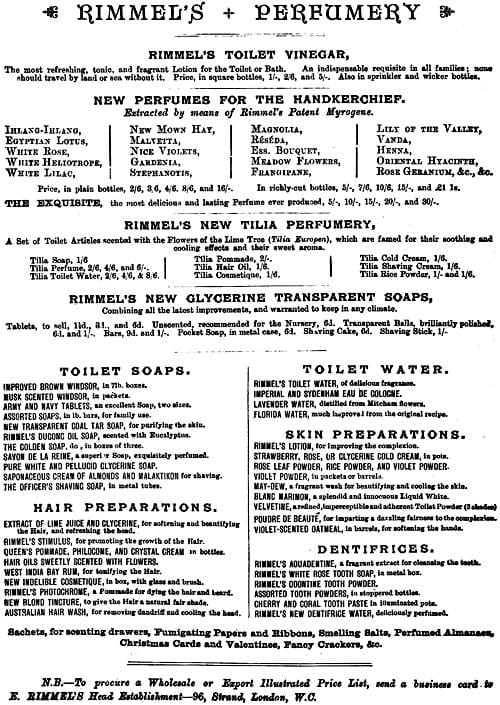
Above: 1884 Rimmel product list.
New skin-care products added by Rimmel included: Lotion for the Skin (c.1852) also known as Rimmel’s Lotion for improving the complexion. It came in two forms: No. 1 preservative; No. 2 curative. May Dew, a wash for the face, arms, and neck could be used instead of soap by women with delicate skins, and there was also Violet-Scented Oatmeal (1866) for softening the hands.
Face Powders included: Rose Leaf Powder, Rice Powder, and Violet Powder; Blanc Marimon (c.1878), a liquid white endorsed by the opera singer, Marie Marimon; Poudre de Beaute (c.1881) scented with White Heliotrope; Perline Powder (c.1866) made with powdered pearl; and Velvetine, a toilet powder in Blanc, Blanc-Rosé, and Rachel shades.
In 1860, Rimmel created Oriental Scunouda, a colourless cold cream said to give the cheeks a beautiful and natural bloom. However it also sold two rouges: the powdered Hebe Bloom; and the indelible Liquid Rose Bloom.
Rimmel eye make-up included Eye-Brow Pencils in Black, Brown, and Blonde shades; and Egyptian Kohl for darkening the eyelids. Of greater significance was Rimmel’s New Cosmetique. Introduced no later than 1855, it is often described as an early mascara but it was developed to darken men’s hair, whiskers, or moustaches not women’s eyelashes.
RIMMEL’S NEW COSMETIQUE for fixing the Hair, Whiskers, or Moustaches, and giving them a beautiful gross and natural black or brown colour without greasing it or them.
(Rimmel advertisement, 1856)
See also: Mascara
New management
Rimmel’s will left his businesses to his wife, Jeanne Betzy Dalphine Rimmel (née Letroublon) [1819-1891], who was living in the south of France when Rimmel died in 1887. The London business was entrusted to Rimmel’s son, Henri Rimmel [1953-1893], and the Paris and Neuilly businesses continued to be managed by M. Paul Raybaud. Records of a William Aubert Rimmel being killed in a work lift accident in 1903 suggests that some of Rimmel’s siblings may also have been involved in the business. Rimmel’s estate was finalised in 1888 and the following year the company’s assets were bought by a newly created company, Eugene Rimmel, Ltd. This may have been formed by Rimmel’s successors but I have no records that idenify its owners.
The shop at 128 Regent Street had been transferred to larger premises at 180 Regent Street in 1886 and the company was forced to move from 96 Strand in 1902 to 79 Strand in the Strand facade of the Hotel Cecil when the Strand was widened. Unlike the previous site at 96 Strand there does not appear to have been any manufacturing carried on there.
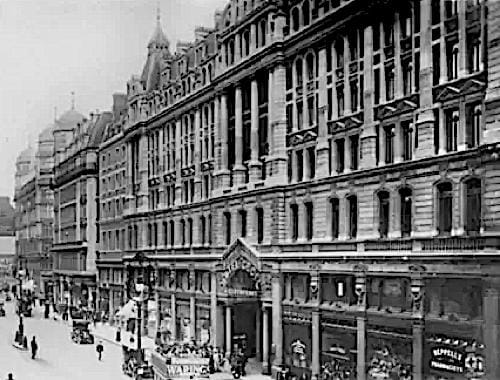
Above: Strand entrance to the Hotel Cecil. Rimmel’s was the third shop to the right of the entrance next to Heppell’s. Built in 1896, the hotel was demolished in 1930 but the Strand facade survived.
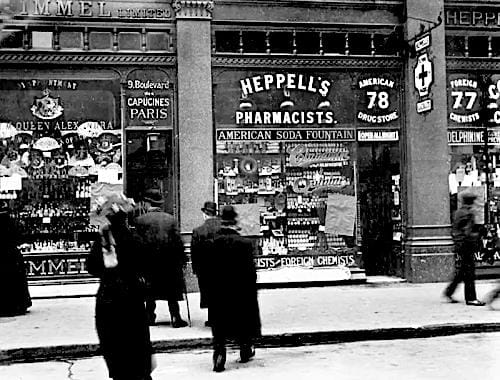
Above: Closer view of the Rimmel shop at 79 Strand next to Heppell’s Pharmacy in the Hotel Cecil.
One of the more significant developments of the new owners was to open a factory at 18 Rue Ficatier, Courbevoie in 1894. Facilities there were expanded over the years.
Interwar period
In 1919, one year after the end of the Great War, we find Rimmel at some new addresses. Its London stores were now at 81 Strand, 119 Regent Street, and 84 Cheapside with a factory at 1a Darnley Road in Hackney. The Brighton address was still at 76 King’s Road, and the Paris outlet remained at 9 Boulevard des Capucines with manufacturing still at Courbevoie.
Eugène Rimmel, Ltd. went public in 1919 and founded Eugène Rimmel S.A. in France in 1920. During the 1920s it began showing an increasing interest in the United States, then the largest market for cosmetics. It contracted Scales & Lisner, Inc. to distribute Rimmel products in America and increased its advertising there after 1924.
In August, 1929, two months before the stock market crash of October, 1929, Rimmel issued debentures totalling £9,000. The money raised was used to buy Breidenbach & Co., Ltd., a small London firm that sold lines similar to that offered by RimmeL. The following year Rimmel, Inc. was founded in New Jersey to handle what it expected to be a growing American business. As with Eugène Rimmel S.A. in Paris, the British company owned all the shares in the American company.
Products
Rimmel did a significant amount of advertising in the 1920s but this dropped off dramatically after 1930 as the company began to experience substantial financial losses. The lack of other records has made it difficult to accretion the company’s product offerings between the two world wars.
The main products advertised by Rimmel in Britain during the 1920s were Hebe Bloom Cream, Crème Marimon, and Water Cosmetique, all products that had been, in one way or another, around for many years. Rimmel had previously used Hebe Bloom to name a powdered rouge but the new product was a type of vanishing cream. It came in a blue glass jar with a gold-tone lid was well as a more portable flat version for the handbag. Crème Marimon was a liquid cream applied with the pad attached to the bottle stopper. It was an extension of Blanc Marimon sold by Rimmel since at least 1878, the revised product now coming in three shades. Water Cosmetique had also been available since at least 1855 in two shades but it was now promoted as an eyelash cosmetic rather than the moustache and hair stainer it had been originally and had its shade range increased to five by 1934. Rimmel did not refer to it as a mascara.
Hebe Bloom Cream: “[S]cientifically blended as to have a unique and entirely different effect on the delicate texture of a woman’s skin.”
Crème Marmion: “Avoid the awkward evidence on your partner’s coat-sleeve; use a ‘whiteness’ that does not rub off.” Shades: White, Naturelle, and Rachel.
Water Cosmetique: “Stroke by stroke you can darken the lashes to just the depth of tint you wish.” Shades: Light Brown, Medium Brown, Dark Brown, Black, and Blue.
As previously mentioned, records of other Rimmel products sold during the 1920s and 1930s remain sparse. It continued to make and sell loose and compact face powders in at least eight shades. However this did not apply to all of the company’s powders. Chrysanthemum Face Powder (1928), packaged in an aluminium box only came in three shades.
Rimmel sold both push-up and twist up lipsticks. The cheaper, smaller lipstick was a twist up, the larger, more expensive version was a push up branded as an automatic. Both lipsticks were introduced in three shades but this was increased to five in the 1930s.
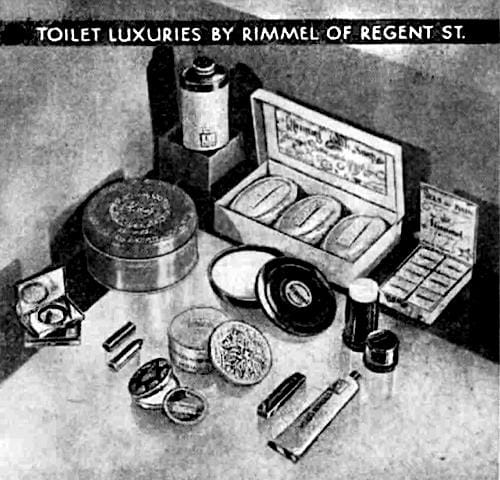
Above: 1932 Rimmel Toilet Luxuries.
For the hands, Rimmel recommended Eau Velvetis, a liquid powder for whitening and softening them before added Velvetis Stick in 1934 which had to be rubbed in after it was applied. By then, Rimmel had also introduced its Onyka Nail Polish. Initially coming in four shades it was removed using Onyka White until the company added a specific acetone-based nail polish remover.
By 1928, Rimmel had added Velvetis Skin Food, a night cream to repair the ravages of the day.
Eau Velvetis: “[F]or whitening and softening the skin.”
Velvetis Stick: “For soft white hands, pass it gently over the skin and rub in briskly.”
Velvetis Skin Food: “It repairs the damages of the day and feeds the glands beneath the skin, so that you with a skin as soft as velvet.”
Chrysanthemum Face Powder: “[A] charming perfumed face powder in light metallic boxes.” Shades: Naturelle, Rachel, and Basane/Ocre.
Lip-Stick: “Once applied, you can forget it for the rest of the day—even after meals”. Shades: Natural, Ruby, and Electric.
Onyka Nail Polish: “A quick drying varnish. Imparts even brilliance to the nails.” Shades: White, Naturelle, Coral, and Pomegranate.
Receivership
The British company made a profit of £3,875 in 1930 but registered a net loss of £13,122 in 1931 and £9,539 in 1932. Further financial troubles followed, and this may explain the tie-ins it did with cigarette companies, in the hope that this would drum up business.
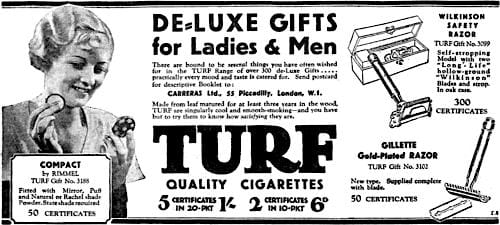
Above: 1933 Rimmel tie-in with Turf cigarettes.
Rimmel made a net trading loss of £3,519 in the year ending December, 1938 which brought its total trading loss to £49,627. This included £2,500 in arrears of rent even after the company had abandoned its store in Regent Street. Clearly Rimmel would have difficulties paying off the debentures it had issued in 1929 which were due in 1944. It went into receivership in 1940 and would not be resurrected until after the Second World War.
Timeline
| 1834 | H. Rimmel opens a shop in Albemarle Street, Piccadilly. |
| 1835 | H. Rimmel moves to Regent Street. |
| 1836 | H. Rimmel opens a shop in Gerrard Street, Soho. |
| 1846 | Partnership between H. and E. Rimmel dissolved. |
| 1857 | Business moved to 96 Strand. |
| 1859 | Retail outlet opened at 24 Cornhill Street. |
| 1864 | Retail outlet opened at 128 Regent Street. New Products: Extract of Lime Juice and Glycerine. |
| 1866 | New Products: Violet-Scented Oatmeal. |
| 1870 | Shop opened in Brighton, England. New Products: Photochrome. |
| 1871 | Beaufort House acquired. |
| 1880 | Paris store moves to 9 Boulevard des Capucines. |
| 1889 | Eugene Rimmel, Ltd. established to acquire the business of Eugene Rimmel. |
| 1919 | Eugene Rimmel becomes a public company. |
| 1920 | Socété Anonyme Eugène Rimmel founded in Paris. |
| 1929 | New Products: Onyka Nail Polish. |
| 1930 | Eugene Rimmel buys Breidenbach & Co., Ltd. Rimmel, Inc. founded in the USA. |
| 1932 | New Products: Crème Lumina (France). |
| 1933 | New Products: Depildry (USA). |
| 1940 | Eugene Rimmel goes into receivership. |
Continued onto: Rimmel (post 1940)
First Posted: 29th August 2025
Last Update: 10th November 2025
Sources
The chemist and druggist. (1859-). London: Morgan Brothers.
Russell, P. (1874). Leaves from a journalist’s note-book. London: Wyman & Sons.
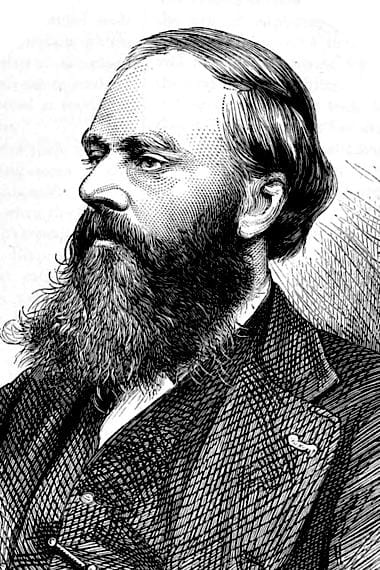
Eugène Jacques Rimmel [1821-1887].
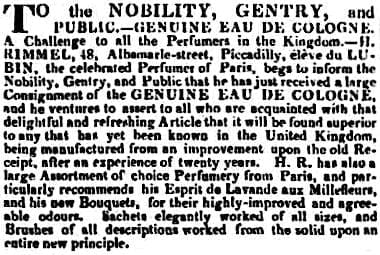
1834 H. Rimmel at 48 Albemarle Street in Piccadilly.
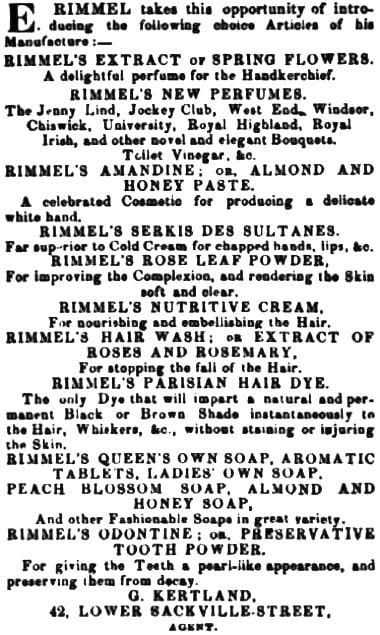
1850 E. Rimmel products.
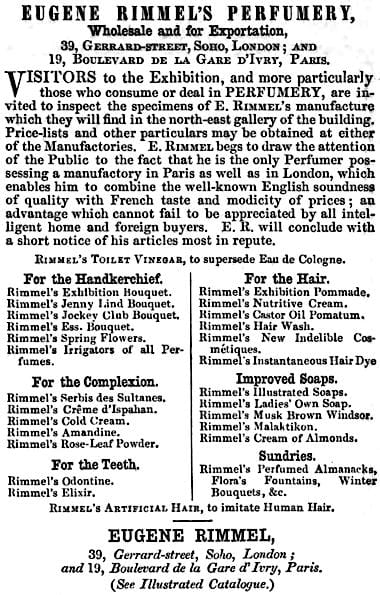
1851 Eugene Rimmel products.
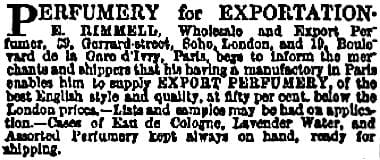
1851 Eugene Rimmel Exports. Manufacturing was cheaper in France than it was in Britain.
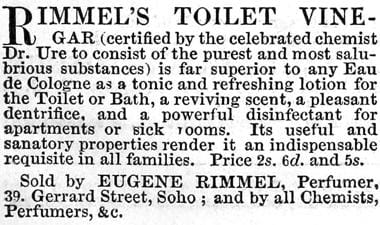
1852 Rimmel’s Toilet Vinegar. An Eau de Cologne substitute used in the perfume fountain at the Great Exhibition. It was one of Rimmel’s best-selling lines.

1856 Rimmel’s New Cosmetique.
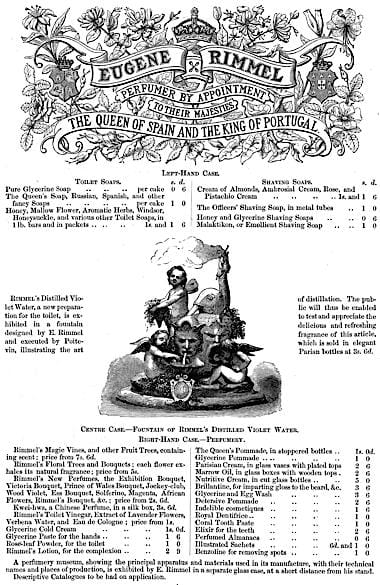
1862 Rimmel.
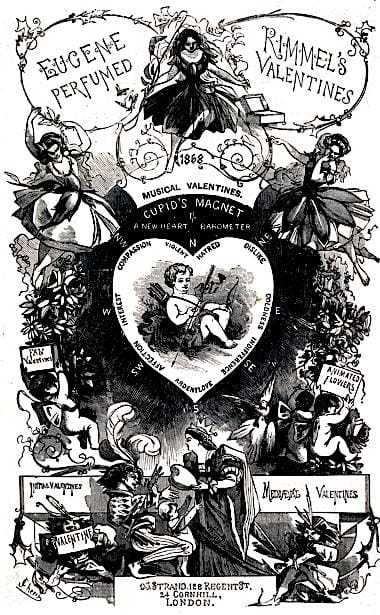
1867 Rimmel trade advertisment for 1868 Valentines.
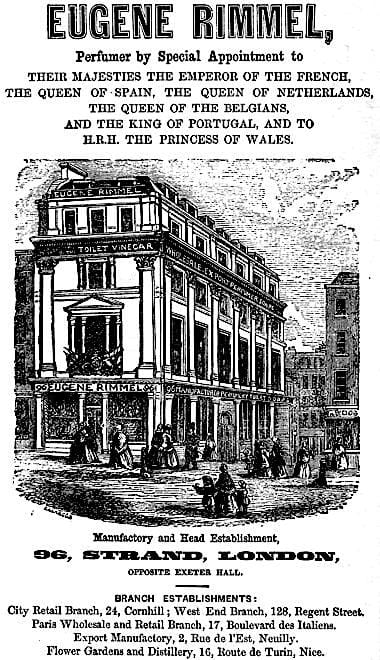
1868 Eugene Rimmel at 96 Strand, London.
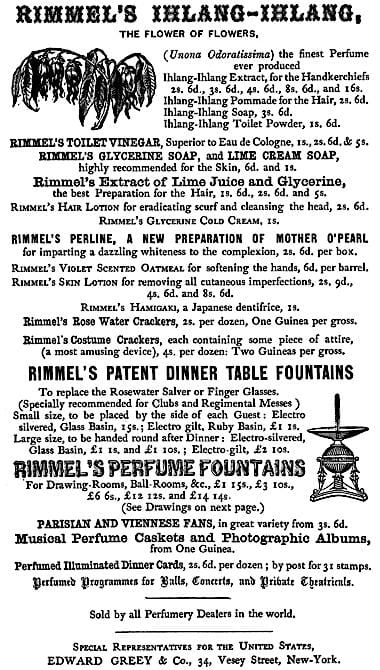
1868 Eugene Rimmel products for sale.
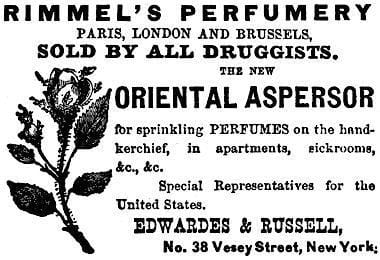
1871 Rimmel (New York).
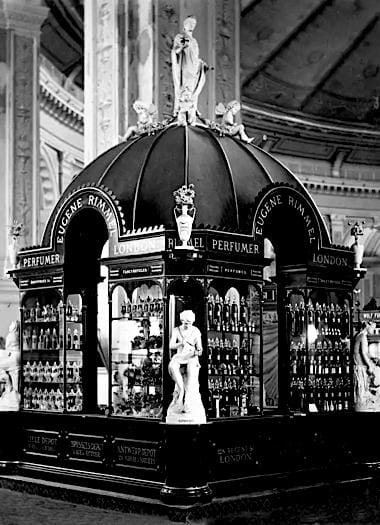
1873 Rimmel display at the Vienna Exhibition.
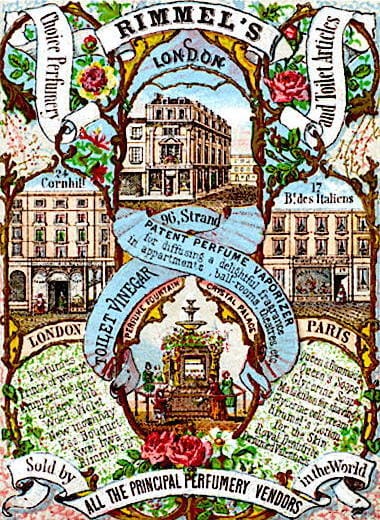
1873 Rimmel Cover page from a Rimmel almanac featuring the perfume fountain at the Crystal Palce and three Rimmel shops at 96 Strand and 24 Cornhill in London, and 17 Boulevard des Italians in Paris.
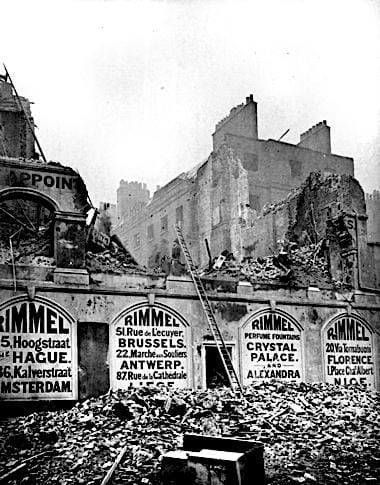
1875 Beaufort Buildings following the fire.
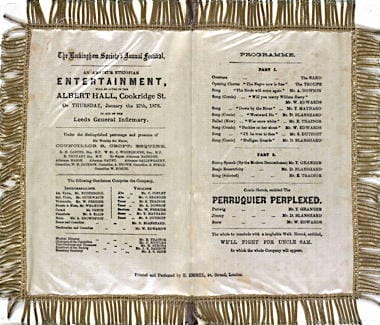
1876 Silk theatre program printed and scented by Rimmel (V&A).
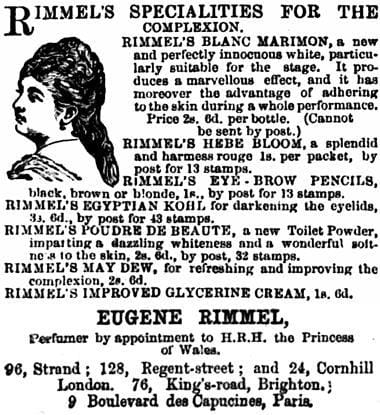
1882 Rimmel’s specialties for the complexion with an engraving of Marie Mamion [1839-1923].
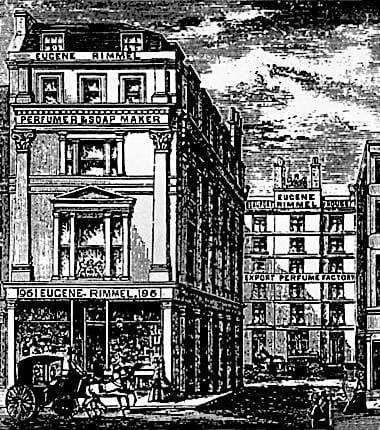
1883 Eugene Rimmel and the Export Perfume Factory.
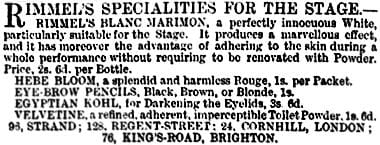
1884 Rimmel’s specialties for actresses. There is no mention of New Cosmetique, presumably because it was not made for women. By this time, actors would have being using greasepaint.
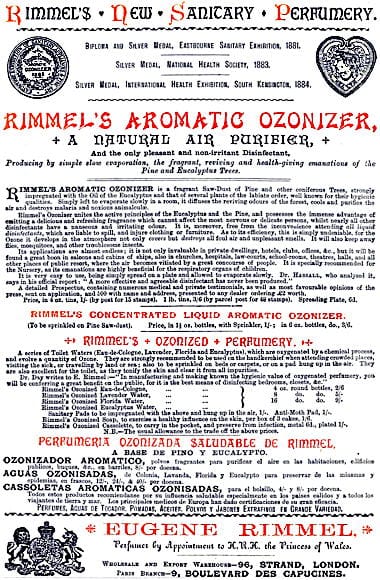
1885 Trade advertisment for Rimmel’s Aromatic Ozonizer.
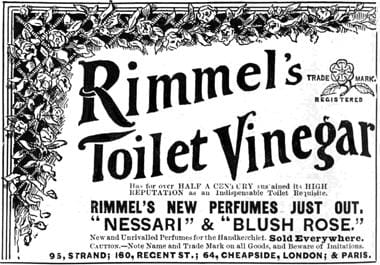
1894 Rimmel’s Toilet Vinegar.
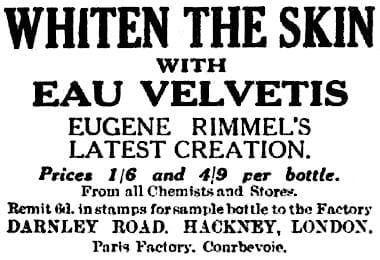
1922 Rimmel Eau Velvetis.
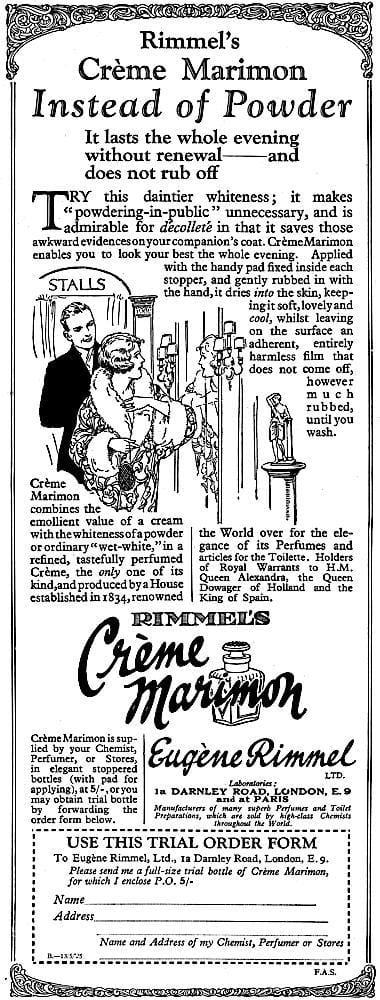
1925 Rimmel Crème Marimon.
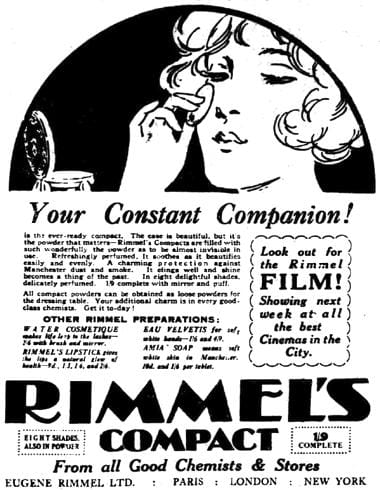
1928 Rimmel Compact.
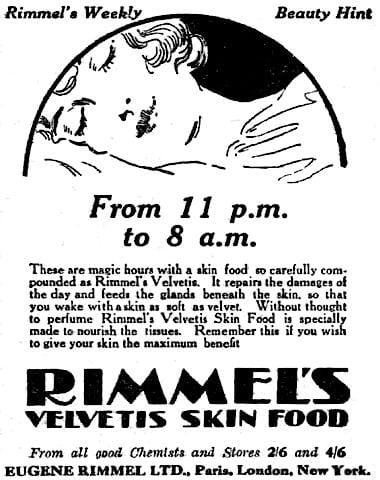
1928 Rimmel Skin Food.
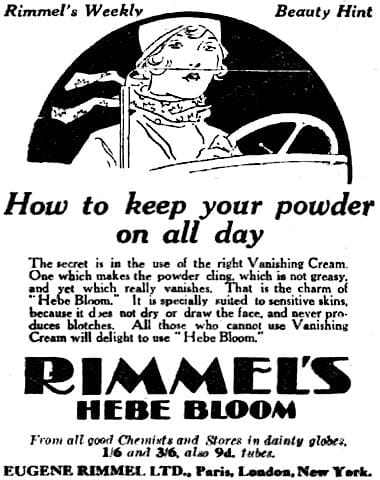
1928 Rimmel Hebe Bloom.
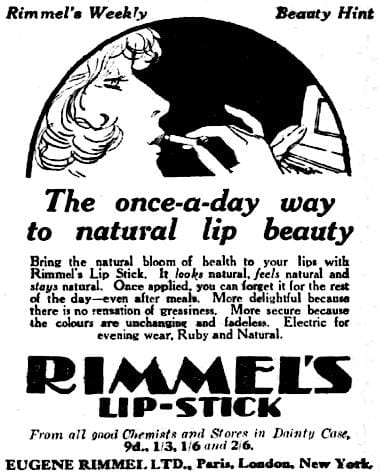
1928 Rimmel Lip-Stick.
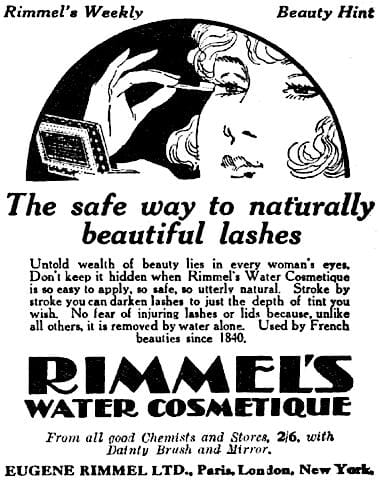
1928 Rimmel Water Cosmetique.
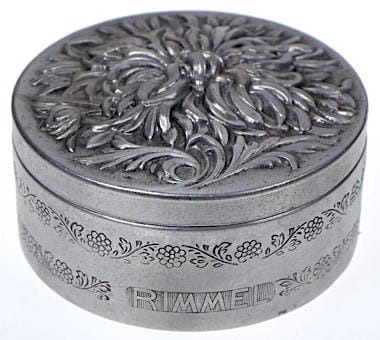
Rimmel Chrysanthemum Face Powder in a silvered aluminium case. These decorative aluminium cases wer popular in France, less so in Britain.
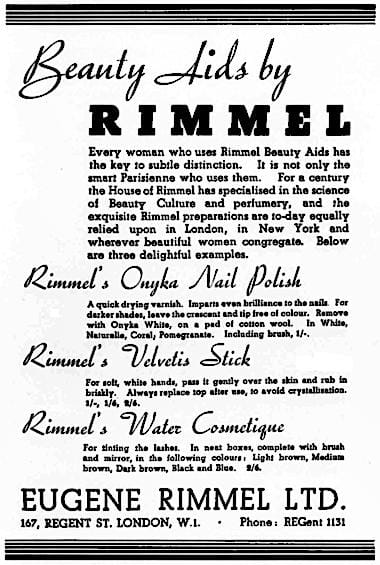
1934 Rimmel Onyka Nail Polish, Velvetis Stick, and Water Cosmetique.
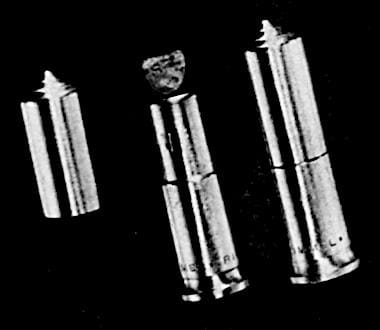
1936 Rimmel Lipstick as sold in the American market. Shades: Mandarine, Flamme, Cerise, Rose, and Naturelle.
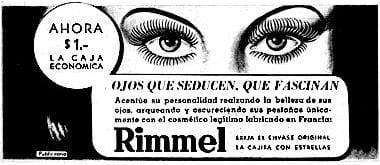
1939 Rimmel eyelash make-up (Portugal).